The short answer: The largest flat rooflight size is set by four things: what the manufacturer will make, how much the glass weighs, what the roof structure can carry, and whether the unit can physically reach the roof. There is no single limit that suits every house, whether you call the unit a rooflight or a skylight. At the free survey we measure your opening and tell you the biggest unit that works, in a fixed written quote.
Bigger is a reasonable thing to want. A wide rooflight over a kitchen extension changes the room. But size drives cost, structure and access, so it is worth knowing what pushes the limit. This page belongs to our guide to flat roof rooflights.
What the manufacturer allows
Every rooflight range has a maximum size, and it varies. Fixed, frameless units can usually be made larger than opening ones, because there is no moving sash to carry. Walk-on glass has its own limits, set by the thickness needed to take a person's weight. We quote from the maker's published sizes and do not stretch them.
If you want something bigger than a single unit allows, the usual answer is two or more units side by side with a structural member between them, or a roof lantern, which is built differently and can cover a larger area.
Glass weight and the structure beneath
A large sealed glass unit is heavy. Toughened, laminated and double or triple glazed panes all add weight, and that weight lands on the kerb and then on the roof structure. A wide opening also means cutting through more joists, and those joists need trimmers sized for the load.
So the biggest unit you can fit is often not about the glass at all. It is about what the roof underneath can carry once the opening is formed. Our page on putting a rooflight into an existing flat roof goes through that structural side.
Getting a big unit onto the roof
A large pane cannot be carried up a ladder. It may need a crane, a mobile platform or a street tower, and on a tall Brighton & Hove terrace that raises questions about the road, the pavement and the neighbours. Where a licence is needed for scaffold on the highway or for a parking bay suspension, we apply to the council for it. Both come from the highway authority, which sets its own fees and timescales.
That route is written down in the access plan in every quote. It records how the unit gets to the roof, who applies for what, and the notice given to neighbours. See the access plan and scaffold licences and parking suspensions.
Planning, Building Regulations and size
Size has a planning side. A house can add rooflights under permitted development as long as each stands no more than 150 mm above the roof plane and stays below the roof's highest point, and a large unit is held to the same two limits. A flat lacks these rights and needs planning permission. A conservation area address on its own leaves the rights in place, but an Article 4 direction, a planning condition or listed status can restrict you, so the planning guide is the place to start.
Under the Building Regulations a new rooflight in a flat roof must reach 2.2 W/m²K, and larger panes have a larger area through which heat escapes, so glazing choice matters more as the unit grows. There is no Building Regulations daylight rule for houses in England, so nothing there forces a size either way. Our Building Regulations guide has the rest, and we handle the notification where the work is notifiable.
Over a conversion the roof tends to belong to the freeholder, and a leaseholder will normally need written consent for the opening, whatever its size. Look at your lease and at flat and leasehold rooflights.
Heat, glare and what a bigger unit does to a room
A very large rooflight lets in a lot of sun. On a south or west facing roof, that can overheat a room in summer. Solar control glass, a blind or an opening unit helps. Venting is dealt with under electric and opening rooflights, and the glazing options under energy efficient rooflights.
Opening versus fixed at large sizes
A fixed pane is simplest to make large, because there is no hinge, motor or seal that has to flex. An opening unit carries a sash on actuators, and the heavier the sash, the more strain on the mechanism. If you want a large view and also want ventilation, one sensible answer is a big fixed unit beside a smaller opening one, which keeps the moving part manageable.
Electric units add a motor and a control, and the cable has to be routed back to a switch or a rain sensor. That is another thing to settle early, because it can affect where the kerb sits.
Big unit, small kerb: the finishing detail
The wider the unit, the more visible the kerb and the more weight sits on the edge of the opening. A frameless design reduces what you see from inside, and a framed one is often more forgiving on an uneven roof. Our page on frameless or framed flat rooflights compares them.
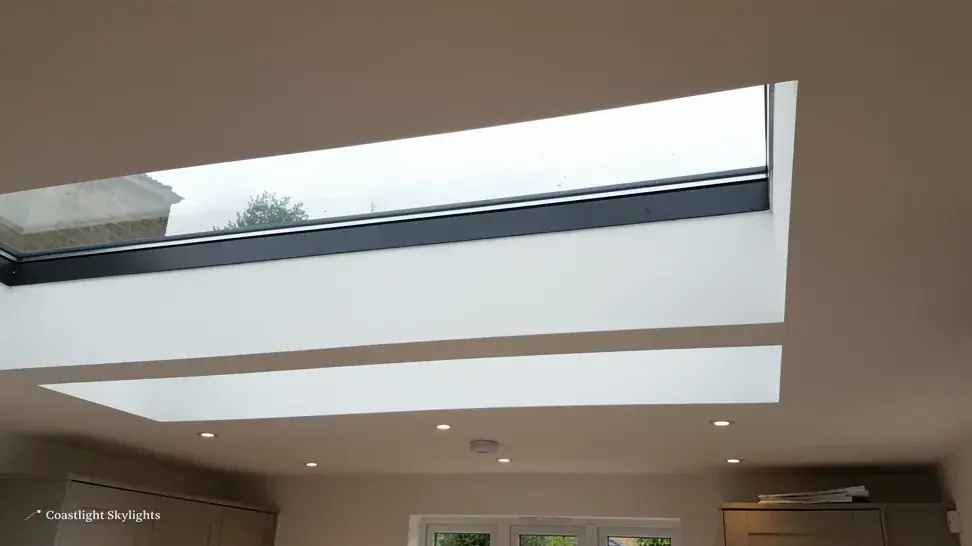
The ceiling inside also matters. A large opening needs a clean reveal, with plaster or lining returned to the glass. The depth of the roof build-up, from the ceiling to the top of the kerb, decides how deep that reveal looks and how much light reaches the room.
Next step
Send us the approximate width and length you have in mind, and a photo of the ceiling below. We will confirm what is achievable at the free survey and set it out in a fixed written quote with the 10-year workmanship guarantee. You can reach us through the quote form or on 01273 282313. For costs, read how much a flat rooflight costs.