The Coastlight guide
Daylight down a tube, from the dome to the diffuser
A sun tunnel is the answer for a room with no wall to put a window in and no space above it for a full rooflight. Coastlight Skylights fits sun tunnels in Brighton & Hove and across the 30 miles around it by road. This page follows the unit from the roof down: the dome, the tube, the diffuser, then the choices, the fitting, the paperwork and what drives the price. It sits inside our wider skylights and rooflights in Brighton & Hove service.

Sheet 01
The roof dome
Scale: the roof
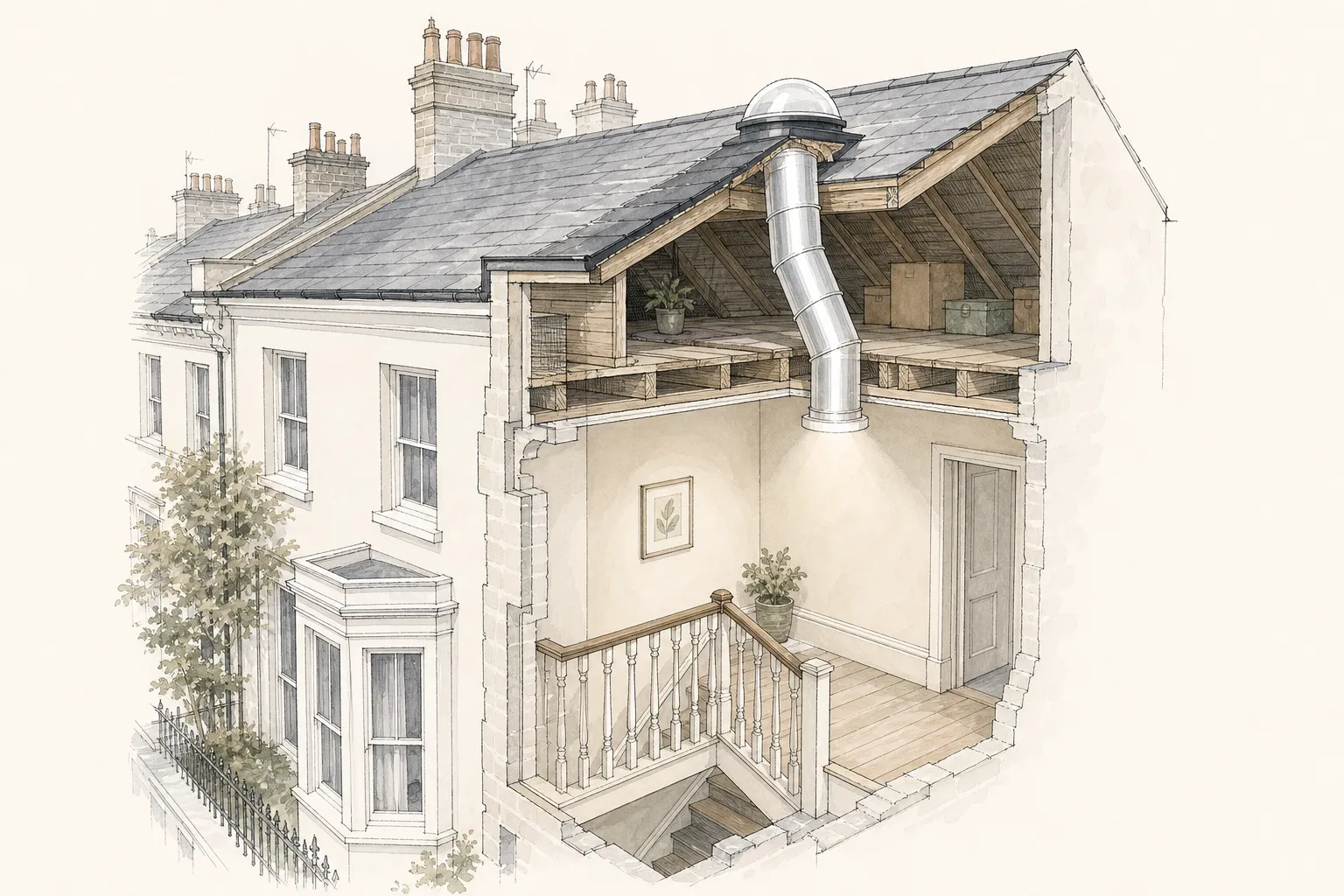
The dome is the only part of a sun tunnel you see from outside, and it does the collecting. It sits on a base that is fixed to the roof, usually a moulded polycarbonate dome over a metal or plastic collar. Light passes through the dome and drops straight into the tube below. The shape matters more than it looks. A clear, slightly raised dome sheds rain and keeps its shape in sun, wind and salt air, and the better ones are shaped to catch low winter light as well as high summer light.
Why the dome is only half the story
What stops water getting under the dome is the flashing. A sun tunnel is small, but the flashing is the same job as it is on a full rooflight. If it is done badly the leak does not show up for a season, and it shows up in the ceiling you were trying to brighten.
| Roof | Base | Flashing |
|---|---|---|
| Flat | The collar stands on a kerb or an upstand | The roof membrane is dressed up and over it |
| Pitched | Set between the rafters | A shaped skirt that laps under the tiles above and over the tiles below, so water runs around the unit instead of into it |
What a dome can and cannot do
A dome gathers daylight. It does not gather heat in any quantity you would notice, and it does not open. If you want fresh air as well as light, a sun tunnel is the wrong unit and a roof window or an opening rooflight is the better choice. If you want a large pane of sky over a kitchen, look at a roof lantern. The sun tunnel suits the spaces in between, where the aim is simply to make a dark room usable without lamps on at midday.
Sheet 02
The reflective tube
Scale: the loft void
Between the dome and the ceiling runs the tube, and this is where a sun tunnel earns its keep or wastes its dome. The inside of the tube is lined with a highly reflective surface. Light entering the dome bounces down the tube with very little loss, so a room several metres below the roof can still be lit from above. A good lining looks like polished mirror. A poor one dulls with handling or kinks into a line of dim patches.
The tube has to cross whatever lies between roof and ceiling. In a bungalow that may be a small loft void with insulation on the floor. In a two-storey house it may be the loft, a landing ceiling, and a short run past a joist or a rafter. The line is rarely perfectly straight, and that is the first choice in the job: a rigid tube for a straight drop, or a flexible tube when the route has to bend. We cover that choice properly in the chapter on rigid or flexible sun tunnels below.
Diameter and the light you get
The diameter of the tube sets how much daylight can travel down it. Pick it from the room, the length of the run and what is in the way, and not from the catalogue page alone.
Wider tube
Carries more light.
- Suits a larger room or a longer run
Narrow tube
Easier to get through a tight loft.
- Enough for a small cloakroom
Insulation and condensation
A tube that passes through a cold loft has a cold skin in winter, and warm air from the room below can meet it. The tube needs to be sealed at both ends and, where it crosses an unheated space, wrapped or installed with a thermal break so warm air does not condense on it. Loft insulation should be fitted around the tube, not squashed against it. Our survey checks the loft before the quote, so the type of tube and the way it is insulated are decided before anyone is on the roof.
Sheet 03
The ceiling diffuser
Scale: the ceiling
The diffuser is the part your family looks at every day. It is a frosted or prismatic panel that sits flush with the ceiling and spreads the daylight into the room. Without it, you would see a bright hole. With it, the light is soft and even, and the panel reads as a light fitting that happens to run on the sun.
Diffusers come in round and square styles to suit the room. The choice is cosmetic, but it should be made at the survey, not left to the end of the job.
| Style | Suits |
|---|---|
| Round | A hallway or a landing |
| Square or flat panel | A modern ceiling, or a bathroom with square tiles |
| Flush with a thin trim | A plastered ceiling, which it leaves looking cleaner |
| Domed | Rooms that want the light spread more widely, as it stands slightly proud |
Light kits and evening use
A light kit adds an LED light inside the diffuser, so the same fitting serves after dark. It runs from a circuit, so it is a job for a qualified electrician and is added to the quote as its own line when you ask for it. The dimming option is worth a look for a bathroom or a landing, where you want a low light at night. A plain unit with no kit costs less and has nothing to maintain, which suits a room that is only ever used in daylight.
Finish, fit and clean-up
The diffuser is the last piece fitted and the first thing you will judge the job by. The ceiling opening is cut cleanly, the plaster edge is sealed to the trim and the surround is left tidy. Plastering a new opening to a perfect finish is a decorator's job, and we say so in the quote so that you can plan for the paint. Where the ceiling is a sloping loft ceiling, the diffuser may be angled to sit square to the finished face.
Sheet 04
Rigid or flexible sun tunnel: which to choose
Scale: the tube
This is the question people ask most when they start looking, and the honest answer is that it depends on the route from roof to ceiling. A rigid tunnel is a straight section of metal tube, polished inside, that carries light with the least loss. A flexible tunnel is a corrugated, reflective tube that can bend around obstacles but scatters more light at each fold.
If the route is a straight drop, choose rigid. If there is a chimney, a tank, a purlin or a run of joists in the way, a flexible tube lets you go around them without altering the structure. A rigid tunnel can also take angled elbows. These work like a gentle bend and are the usual solution for a pitched roof where the dome sits on the slope but the ceiling is level below. Our page on rigid or flexible sun tunnels goes through it in more detail.
| Point | Rigid tunnel | Flexible tunnel |
|---|---|---|
| Light carried | Highest, with a clean mirror finish | Lower, more loss at each bend |
| Route | Straight, or with fixed elbows | Bends around obstacles |
| Best for | Longer runs and darker rooms | Short runs with something in the way |
| Fitting | Needs a clear line | Quicker where the loft is cluttered |
| Care at survey | Check the line for timbers | Check that it can be kept taut |
Why the tube is where light is won or lost
Every bend in a tube costs some light, and every stretch of dull or creased lining costs more. That is why a dark, long landing is a rigid job and a short cloakroom can be flexible.
A short run changes the answer
On a short run the difference in light is small, and the flexible tube is a sensible choice because it is quick to fit and easy to place. On a long run, the loss adds up, and a rigid tube is worth a little more effort. We tell you which we would use and why, and we price both if the route could go either way. How long a run can be before the light drops away is covered in how long can a sun tunnel be.
Sheet 05
Fitting a sun tunnel to a flat or pitched roof
Scale: the flashing
The unit is the same family on either roof, but the fitting is different, and the roof type decides the base. The page on sun tunnels on flat and pitched roofs goes deeper. Here is the short version.
On a flat roof
A flat roof needs a raised kerb or a purpose-made base so the dome stands clear of standing water. The membrane, whether felt, single-ply or liquid-applied, is dressed up the kerb as an upstand and finished under the collar. Where the roof is a Brighton butterfly roof or sits behind a parapet, the valley gutter and the outlet may be close to the dome position, and we check the fall and the drainage before choosing the spot. The same flat roof rooflights detailing rules apply, because a leak does not care how small the unit is.
On a pitched roof
A pitched roof takes a shaped flashing kit sized to the tile or slate profile, lapped into the courses around it. On older roofs the tiles may be fragile and the battens soft. Any batten that has to be replaced at the unit position is renewed before the flashing goes on, not afterwards, and the quote says so.
- Lift the tiles around the dome position.
- Set the base between the rafters.
- Relay the tiles with the correct laps over the flashing kit.
- Turn the tube so the dome sits on the slope and the tube meets the ceiling plumb.
Sheet 06
How a sun tunnel is installed
Scale: the job
A sun tunnel is among the quicker rooflight jobs, but quick does not mean casual. Each stage has a reason, and the order matters. The page on how a sun tunnel is installed sets out the full sequence. This is the outline.
- Free survey. We visit by appointment, look at the roof from outside, then go into the loft and the room below. We mark the dome position and check the route for obstacles.
- Written quote and access plan. You receive a fixed written quote. It includes the access plan, which says how we reach the roof, who applies for any scaffold licence or parking bay suspension, and what Building Control needs.
- Roof opening. The tiles or the membrane are opened at the dome position. We secure the base and flash it into the roof covering.
- Tube run. In the loft the tube is cut to length, joined and sealed. It is supported so it does not sag, and the insulation is laid around it.
- Ceiling and diffuser. The ceiling is opened to the marked size and the diffuser is fixed. Light kits, if ordered, are wired by an electrician.
- Handover. We clear the dust and tidy the room. Your 10-year workmanship guarantee starts at handover.
The guarantee covers our workmanship on the installation, the flashing and the fit of the unit. You can read how it works on the our guarantee page.
Access for a small job
If a scaffold stands on the pavement, the highway authority, which is Brighton & Hove City Council or the county council for roads outside the city, issues the licence. We apply for it. A parking bay suspension is a separate application and we make that too. Read the scaffold licences and parking suspensions guide for how that works across the area.
Sheet 07
What affects the cost of a sun tunnel
Scale: the price
We do not print a price on this page, because the figure depends on the house. We quote after the survey, and the quote is fixed and in writing. What follows is what changes it, so you can see why two similar-looking jobs may be priced differently. A fuller discussion is on how much does a sun tunnel cost, and our costs page covers the wider rooflight range.
The factors that move the price
| Factor | Effect |
|---|---|
| Tube length and type | A longer run uses more tube and takes longer to fit. Rigid tube with elbows costs more than a short flexible run |
| Diameter | A larger diameter costs more as a unit and needs more room to pass through timbers |
| Roof covering | Slate, clay tile and single-ply membrane each take different flashing kits and different working methods |
| Access | A roof reached from a rear garden is simpler than one that needs a tower from the street, or a licence for a scaffold on the highway |
| Extras | A light kit, a dimmer, an opening ceiling surround, or a vented dome are all added lines |
| Making good | Tidying the ceiling opening is included. A full redecoration is not, and the quote says so |
Questions about the VELUX range
People ask what a VELUX sun tunnel costs, and the answer depends on the size, the tube type and the roof it fits. We install the VELUX range and other makes of tubular daylight device. A VELUX unit is made to fit with its own flashing, which is useful on some roofs and unnecessary on others. See our page on VELUX windows for the wider range.
Sheet 08
Where a sun tunnel earns its place
Scale: the room
A sun tunnel suits rooms where you cannot have a window and cannot have a full rooflight. Our guide to sun tunnels for hallways, landings and bathrooms goes room by room.
| Room | What makes it a candidate |
|---|---|
| Internal landing | Sits mid-house with no outside wall to give it a window |
| Hallway | No window, and no place for a full rooflight |
| Bathroom or cloakroom | Keeps its privacy and its wall space |
| Utility room, walk-in wardrobe, stairwell | Often windowless, with no way to fit a full rooflight |
The dark landing
On a Brighton terrace the landing often sits in the middle of the house with a bedroom on each side, and no outside wall to give it a window. A sun tunnel through the loft above can light it without touching the bedrooms. The tube usually has a short, straight run, so a rigid tunnel is common.
The bathroom and cloakroom
A bathroom lit by a sun tunnel keeps its privacy and its wall space. The sealed tube does not let steam into the loft, and the diffuser can be a moisture-friendly type.
Cloudy days, and whether it is worth it
Brighton gets grey days, and a sun tunnel works in them, as any daylight device does. It collects light, not sunshine, so on an overcast day the room is dimmer than on a bright day but still brighter than it would be without it. The page on do sun tunnels work on cloudy days says more. Whether it is worth it depends on the room and what you spend on lamps. Our answer to are sun tunnels worth it is a straight one.
Sun tunnel
Suits a small or internal room with no roof space above for a larger unit.
- Small roof opening
- Light travels down a tube
- Does not open
Roof window or rooflight
Suits a room directly under the roof with space for a larger opening.
- Larger roof opening
- View of the sky, and often ventilation
- More structural work
Sheet 09
Planning, Building Control and leasehold
Scale: the paperwork
A sun tunnel is a small unit, but it still touches the roof, and that brings rules. Here is how they apply to a house in Brighton & Hove.
Planning permission
Rooflights on houses can fall within permitted development, Class C. Among the conditions, the unit may project no more than 150 mm from the roof plane and must not stand taller than the roof's highest point. Our planning guide goes through it.
| Situation | Position |
|---|---|
| Conservation area | Class C rights stay, unless an Article 4 direction or a planning condition removes them |
| Listed building | Listed building consent in addition |
| Flat | Outside permitted development, so planning permission is needed |
| South Downs National Park | The park authority is the planning authority |
Notifying Building Control about a dome and tube
Cutting the hole for the dome and tube counts as building work. Building Control looks at the structure, the weathering, fire and energy. We make the Building Control notification on any notifiable sun tunnel job, filing it with the council or with a registered building control approver. Replacing a whole unit like for like is also building work and must meet Part L. The wider rules are in our Building Regulations guide. The units are installed to current Building Regulations, and the survey tells you which route applies to yours.
Flats and shared roofs
Where a house has been converted into flats, the freeholder generally owns the roof. Under the lease, a leaseholder usually must get a licence for alterations, which is the freeholder's consent in writing. Check your lease, and see rooflights in flats and leasehold buildings. We include neighbour notice and any consent step in the access plan, so nothing is left until the morning of the job.
Sheet 10
Brighton and Hove roof types
Scale: the street
The city has a mix of roofs that a national brochure does not describe, and each one changes how a sun tunnel is planned. We design the fitting around the building in front of us.
Butterfly roofs and parapets
Regency and Victorian terraces often have a butterfly roof: two shallow slopes falling inward to a central valley gutter, hidden behind a parapet wall. The dome has to sit on one slope, clear of the valley, with its flashing lapped so water runs past it into the gutter. Getting materials up is the harder part. Everything goes over or around the parapet, so the access plan names the route, whether that is a rear scaffold through the garden or a platform from the street.
Mansards, top-floor flats and steep streets
| Situation | What shapes the fitting |
|---|---|
| Mansard | A steep lower slope and a shallow upper one. The dome can sit on the upper slope, where the tile kit is easiest, or on the lower slope if the room below needs it. The dormer cheeks and the party line limit where it can go |
| Converted flat on the top floor | Often the shortest run from roof to ceiling, which suits a flexible tube and a compact dome. The roof belongs to the freeholder, so the access plan lists the consent step and the notice to neighbours |
| Steep street with permit parking | A tower on the pavement or a delivery vehicle in a bay both need the council |
Sheet 11
Coastal exposure and how long a unit lasts
Scale: the coast
A sun tunnel on the south coast takes more weather than one inland. These are matters of material and fixing, and we choose for them.
| Weather | Effect | Our choice |
|---|---|---|
| Salt air | Attacks cheap fixings and bare metal | Corrosion-resistant fixings |
| Wind | Lifts anything not properly fixed | A flashing that is bedded and secured, not simply stuck on |
| Gulls | Land on a dome, scratch it and leave their mark | A tough polycarbonate dome |
Our page on how long do sun tunnels last covers the signs. If you have a failed unit now, look at our service for misted and failed rooflights, and for glass that is doing well but the whole building needs more efficiency, energy efficient rooflights.
For a roof that someone may need to walk across, or a flat roof that is used, a sun tunnel dome is not a walking surface. If you need to cross it, ask about walk-on rooflights. For a house in a conservation area where a visible dome is a concern, conservation rooflights may be a better match.
Ready to see whether a sun tunnel suits your roof? Book a free survey and we will talk it through with the loft in front of us. Go to the quote form, or use the contact page. The full range is on our skylights and rooflights hub.
Sun tunnel queries, answered plainly
Flex tunnel or rigid tunnel?
Rigid carries the most light and suits a straight drop. Flexible bends around obstacles and suits a short run with something in the way. We pick after looking in your loft.
Are sun tunnels worth it?
For an internal landing, bathroom or hallway with no window, they usually change how the room is used. For a room that already has good daylight, they add little. The survey tells you which you have.
What is the typical cost of a sun tunnel skylight?
It depends on the tube length, the diameter, the roof covering and how we reach the roof. After the free survey you get a fixed written quote.
How much does a VELUX sun tunnel cost?
The figure depends on the size and the roof it fits. We install the VELUX range, and the fixed written quote after the survey shows the fitted price.
How long do sun tunnels last?
The tube lasts a long time. The dome and the seals are the parts that age, especially on a coastal roof. Our installation carries a 10-year workmanship guarantee.