The short answer: There is no single maximum sun tunnel length that suits every house. Each manufacturer publishes a limit for its own tube, and the limit shrinks with every bend you add. In practice the real ceiling is how much daylight survives the trip, so a shorter, straighter tube always performs better. We measure the run in the loft at the free survey and tell you what your roof can support.
People usually ask this when the room they want to light with a sun tunnel, a tube-fed kind of skylight, sits well below the roof, perhaps on the first floor of a tall terrace with a loft above. This page belongs with our main sun tunnels page and explains what controls the length, why it matters and what we do when the run is awkward.
What "length" means on a sun tunnel
The length is the distance the light travels from the dome on the roof to the diffuser in the ceiling. It is not the height of the building. It is the actual path through the tube, including any angled sections.
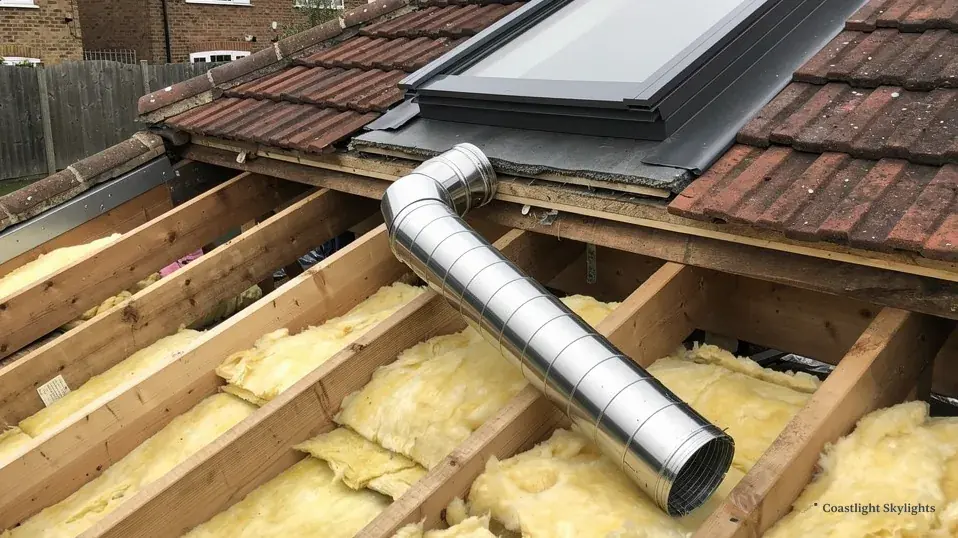
That path usually has three parts. First there is the short collar through the roof itself. Then comes the run through the loft or the roof void. Last is the drop through the ceiling to the diffuser. In a flat-roofed building the run can be quite short. In a house with a deep loft, or a loft that has been boarded and used for storage, it can be much longer.
Why the limit exists
Light bounces down the inside of the tube. Each bounce loses a little, and a longer tube means more bounces. Eventually so little arrives that the diffuser looks like a dull disc rather than a source of daylight.
Because of this, manufacturers set a maximum for each tube diameter, and many also give a shorter recommended run. Always follow the data sheet for the product we fit rather than a number from a forum. We will show you that sheet at the survey if you want to see it.
Straight beats bent
Every elbow in the tube costs you light. A single gentle bend is usually acceptable. Two or three, and the benefit falls away quickly.
This is the most important point on this page. A short straight tube can outperform a longer, bent one even when the longer one is wider, simply because the light has fewer chances to be lost along the way. That is why we plan the route before we settle the tube size. So the question to ask is not "how long can it be", but "how straight can we make it".
| Factor | Effect on the light |
|---|---|
| Longer run | Less light arrives |
| Each bend | Less light arrives |
| Wider tube | More light can travel |
| Rigid, polished tube | Reflects better than a ribbed flexible one |
| Clear sky exposure of the dome | More light collected at the top |
Rigid or flexible changes the answer
A rigid tube has a polished inside and reflects well, so it carries daylight further for a given width. A flexible tube is easier to route round obstacles, but its ribbed surface scatters more light. For a long run we nearly always prefer rigid sections, joined with a bend only where the loft forces one. The full comparison is in rigid or flexible sun tunnels.
When the run is too long for a sun tunnel
Sometimes the honest answer is that the tube would be too long or too bent to work well. We tell you so at the survey. You then have other options.
- Move the diffuser to a different spot on the ceiling, so the tube can go up more directly.
- Choose a wider tube, if the roof and loft can take it.
- Look at a roof window or flat roof rooflight if the room sits directly below the roof. See roof windows and flat roof rooflights.
The right choice depends on the room as much as the roof. Our page on whether sun tunnels are worth it helps you judge that.
How the roof affects the tube
On a pitched roof, the dome sits on a flashing and the tube leaves at an angle to the slope. On a flat roof, it sits on a kerb and the tube can drop almost straight down. That difference often decides how many bends you need, which is why flat and pitched roofs get their own page.
Fitting any sun tunnel means cutting a new opening in the roof, which is building work. Where the opening is notifiable, we notify Building Control, and you can read more in the Building Regulations guide. If you live in a flat, check the lease for freeholder consent, and bear in mind that permitted development does not cover rooflights on flats. Our leasehold rooflight guide has the detail.
Insulation and condensation in a long run
A tube passing through a cold loft carries warm, damp air from the room below up towards a cold surface. A long run gives that air more cold surface to meet. So the tube needs to be sealed at the ceiling and, where the loft is cold, the sections need to be properly insulated and joined so moisture does not collect inside.
This matters most for bathrooms. A sun tunnel gives daylight, not ventilation, so a bathroom still needs an extractor fan whatever you decide about the tube. We note the fan position at the survey so the two do not clash in the same ceiling space.
What the survey measures
At the free survey we look in the loft, find the line from the roof to the ceiling spot you have in mind, and count the bends it needs. We check the roof covering and the structure around the opening. We also plan how to reach the roof, and the written access plan in your quote records it. A fixed written quote follows, so the price does not change once we start.
To see how the process runs on the day, read how a sun tunnel is installed. To have your own run measured, request a free survey, or go back to the sun tunnels hub to compare the other questions we cover.