The short answer: A sun tunnel is usually one of the more modest ways to bring daylight into a dark room, but the sun tunnel cost depends on the tube length, whether it is rigid or flexible, the roof covering and the access to the roof. We do not publish guide prices. The free survey ends in one fixed written quote for your house.
Anyone asking about sun tunnel cost is probably weighing it against a roof window or a rooflight, the other kinds of skylight. A sun tunnel is a small domed collector on the roof, a reflective tube through the loft and a diffuser in the ceiling. Because it needs no large opening and no new structure above the room, it is often the lighter job. The product background sits on our sun tunnels hub, and this page is about what moves the price.
What you are paying for
| Part | What it involves |
|---|---|
| Roof collector | The dome and flashing, matched to tile, slate or flat roof |
| Tube | Rigid or flexible, cut to the run through the loft |
| Ceiling diffuser | The visible fitting in the room, with a neat finish |
| Access | Ladders, a tower or scaffold, depending on the building |
Each of those rows turns into a line in the written quote, so you can see where the money goes.
Tube length and type
The longer the run between roof and ceiling, the more tube is needed, and the more care goes into keeping the reflective surface clean and the joints tight. A rooflight at the top of a short loft void needs very little tube. A deep loft, or a ceiling well below the roof line, needs more. Bends also matter: every angle costs a little light and adds fitting time. Rigid tubes run straight and carry more light. Flexible ones can wind around obstacles such as joists, pipes and ductwork, at some loss of brightness. Our page on rigid or flexible sun tunnels compares them, and how long a sun tunnel can be sets out the practical limit.
Roof type and covering
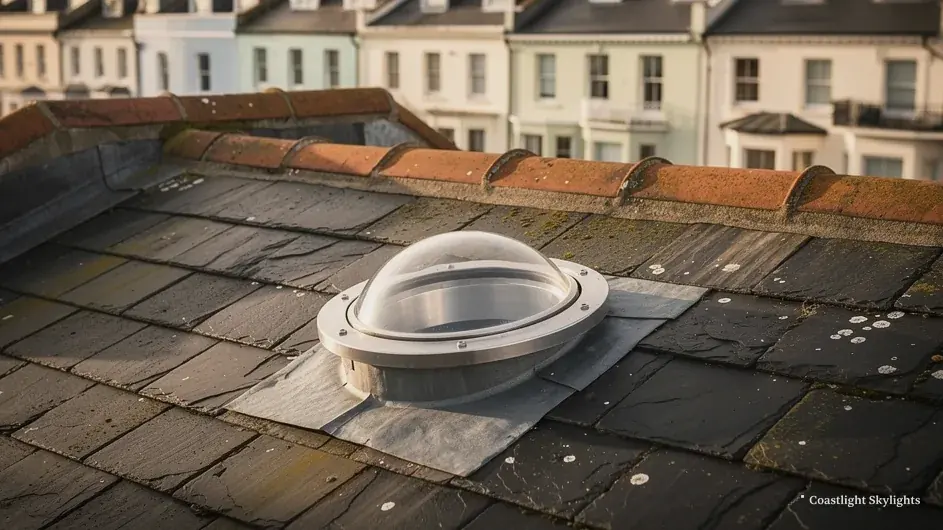
A sun tunnel through a pitched roof needs a flashing kit to suit the covering: plain tile, interlocking tile, slate or something else. Slate and clay take more care to lift and relay around the collector. On a flat roof, the collector sits on an upstand that is weathered into the felt or membrane, so the roof finish affects the work. Our page on sun tunnels on flat and pitched roofs covers the differences.
The room and the ceiling
The finish at the ceiling affects the work. A plain plasterboard ceiling is straightforward. A lath-and-plaster ceiling in an older house needs more care when it is cut, and a fire-rated ceiling needs the right detail so the protection is not compromised. Decoration afterwards is a separate matter. If you want a light in the diffuser, or a version with a ventilation function, that is a further option. Hallways, landings and bathrooms are the most common places for them, and we have a page on sun tunnels for hallways, landings and bathrooms.
Access, licences and consents
On a bungalow with a rear garden, getting to the roof can be simple. On a tall Brighton terrace, the route may need a tower from the street, a scaffold licence from the highway authority or a parking bay suspension. We apply for those, and they feed into the price. The detail is on our page about scaffold licences and parking suspensions. Each quote includes the access plan, one written page covering the route up, who applies for what, the neighbours, the Building Control route and the price.
If you live in a flat, the roof is normally the freeholder's, and a licence for alterations may be needed before anything is cut. See flat and leasehold rooflights. Planning can also come into play for flats, Article 4 areas or listed buildings, and our planning guide explains where. The tunnel is installed to current Building Regulations, and if the job needs notifying, Building Control hears about it from us.
Replacing an old unit
If you already have a sun tunnel that has fogged inside the dome or stained the tube, the cost question is a replacement one. A collector with a failed seal or a cracked dome is swapped for a new one, and the tube and diffuser are checked at the same time. Because the opening and the route already exist, a like-for-like replacement is often simpler than a first installation, though the roof covering around the old flashing still needs to be dealt with properly. We assess the condition at the survey and write the replacement into the quote.
For a bigger swap, such as moving from a sun tunnel to a roof window in the same spot, the job changes: a larger opening, trimmed rafters and a different Building Control position. We talk through that choice with you before anything is priced, so the quote you receive is for the job you actually want.
Cost compared with value
A sun tunnel can look inexpensive next to a roof window, but it is a different product, so the comparison is not about price alone. A sun tunnel lights a small space and does not offer a view or reach the same level of brightness as a larger opening. If the room can take a bigger unit, a roof window or lantern may be worth discussing. We lay out the thinking in are sun tunnels worth it, and the question of performance in dull weather is on do sun tunnels work on cloudy days.
How we price it
- Free survey. We look at the roof, the loft and the ceiling, by appointment.
- Route and type. We agree the tube type, the position and any bends.
- Fixed written quote. One figure, with the access plan attached.
- Installation. Our work is covered by the 10-year workmanship guarantee.
You can read how the work goes on site in how a sun tunnel is installed, and the guarantee is explained on our guarantee page. For wider pricing context, visit costs. Return to the sun tunnels hub or ask for a free survey.