The short answer: Yes, cleaning flat rooflights now and then keeps them clear. Because the glass sits close to level, leaves, dust, bird droppings and sea air deposits stay on it rather than washing away. A rinse and a soft wipe from a safe position is normally enough. If the glass is misted between the panes, cleaning will not help, and the unit needs assessing for replacement.
A flat rooflight, or flat skylight, has an easy life compared with a roof window on a steep slope, and a harder one in a different way. It rarely gets the run-off that clears a pitched pane. This page is part of our guide to flat roof rooflights.
Why flat glass collects dirt
On a pitched roof, rain pulls dust down the glass and off the edge. On a flat roof the water spreads, dries in place and leaves a film. Trees overhead drop leaves and sap. Gulls leave droppings. Near the coast a fine salty deposit settles and dries, and it dulls the glass faster than you would expect.
Some flat rooflights have a self-cleaning coating on the outer pane, which helps the glass shed dirt. It does not make the unit immune, and harsh cleaning can damage it.
How to clean flat rooflights safely
The safest method is the one that keeps you off the roof. Where you can reach the glass from a window, a balcony or a stable platform, use warm water with a little washing up liquid and a soft brush or cloth, then rinse. A long-handled soft brush used from a first floor window can reach a low roof.
- Clear the loose debris. Brush leaves and grit off the glass and from around the kerb before any water goes on, so nothing is dragged across the surface.
- Wash with mild soapy water. Use a soft sponge or brush, working from the top edge down.
- Rinse well. Clean water, plenty of it, so no soap film dries on the pane.
- Dry or leave to drain. A squeegee on a pole helps on larger units. Do not use abrasive pads, scrapers or strong solvents.
Never step onto a rooflight that is not rated as walk-on. Glass that looks solid can break under a person. If you are not sure whether yours is walk-on, treat it as if it is not. Our page on walk-on rooflights explains the difference.
Check the roof around the glass
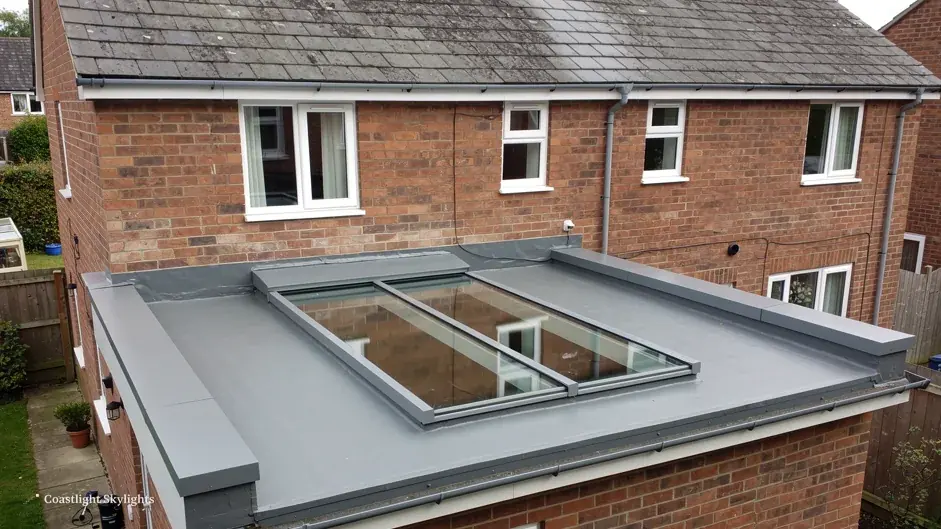
A clean pane is only part of the picture. While you are looking, check the area around the unit. Blocked outlets and leaf-filled gutters are what cause water to pool near the kerb. Look at the upstand where the roof covering turns up to meet the kerb for lifted edges or gaps. Our page on upstands and falls shows what a sound junction looks like.
If you see damage to the covering, a split seal or a stain on the ceiling below, the question moves beyond cleaning. We install and replace rooflights, and the next step is a survey to see whether the unit or the surrounding roof needs replacing. See misted and failed rooflights.
Cleaning the inside
The inner pane gets dusty too, especially over a kitchen where grease collects. A damp microfibre cloth does the job. If you can see moisture or a cloudy film that wipes nowhere, it is inside the sealed unit. That is a failed seal. Wiping will not remove it, and the unit is replaced rather than cleaned.
Opening rooflights have hinges and seals that benefit from a wipe too. Our electric and opening rooflights page covers how they are put together.
What not to use
Pressure washers force water past seals and strip coatings, so leave them in the shed. Bleach and strong solvents cloud some coatings and can mark the kerb covering. Metal scrapers scratch glass for good, and a scratch collects dirt faster than the glass did before. Plain water and a soft cloth do the job almost every time.
Avoid cleaning in strong sun, because the water dries in streaks before you can rinse. An overcast day is better.
Cleaning around lanterns and sun tunnels
A roof lantern has more edges and bars where dirt gathers, and the guttering at its base can fill with leaves. A sun tunnel has a small dome outside that clears itself more easily, but the dome still needs a wipe where trees overhang. The same rule applies to both: mild soap, soft cloth, and no climbing.
When cleaning is awkward
Some rooflights sit where you cannot reach them. A tall Brighton & Hove terrace with a roof behind a parapet, or a flat roof over a basement flat with no outside access, are typical. Do not climb to reach them. If a replacement is the end result, our written access plan records how the roof will be reached, who takes on the scaffold licence and any parking bay suspension, and how neighbours are notified. Read more on the access plan.
How often to look
There is no fixed timetable that suits every roof. A rooflight under a tree needs attention after leaf fall. One on an open roof, away from trees, may only need a wash when you notice the glass dulling. A sensible habit is to glance at the glass from inside on a bright day, since dirt shows as a haze against the light, and to check the roof around it after a storm.
Keep the outlet and gutter clear as well. A rooflight on a roof that drains freely stays cleaner than one beside a blocked gully, because standing water is what leaves the worst marks.
Is a self-cleaning coating worth having?
Many glazing options include coatings that help rain wash dirt away. On a near-flat roof they help less than on a pitched one. If cleaning access is poor, ask about the glazing at the survey. We explain the options, and a fixed written quote names what is included. A replacement rooflight in a flat roof must meet 2.2 W/m²K under the Building Regulations; see the Building Regulations guide. The work comes with our 10-year workmanship guarantee.
Planning a new rooflight or a replacement? Send the quote form or call 01273 282313. For costs, see how much a flat rooflight costs.