A flat rooflight, or flat roof skylight, is only as watertight as the roof covering it is joined to. Whether your roof is bitumen felt, an EPDM rubber sheet or GRP fibreglass decides how the kerb is formed, how the upstand is dressed and how the work is programmed. This page walks through each covering, what it means for a flat roof rooflight in Brighton & Hove, and what we check during the survey.
Why the roof covering matters more than the glass
People choose a rooflight by looking at the glazing. The roofer looks somewhere else: at the line where the glazing's kerb meets the waterproof layer. That junction is where a flat roof either stays dry for decades or starts to let water in at the first heavy storm.
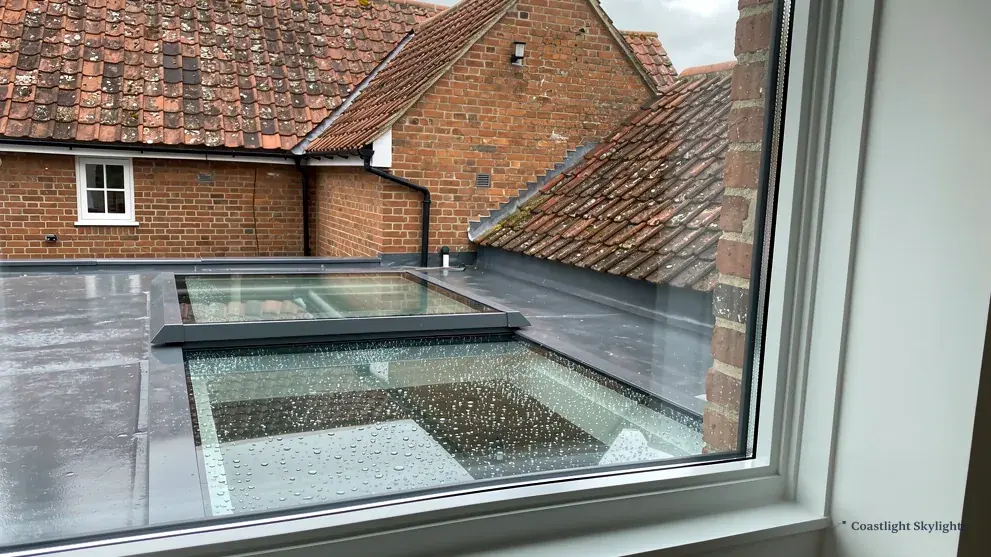
Every flat rooflight sits on a kerb, a short upstand that lifts the unit above the surface of the roof so that standing water cannot reach the frame. The covering is carried up the outside of that kerb and finished beneath the rooflight's flashing or cill. Felt, EPDM and GRP can all do this job well. They do it in different ways, with different materials and different tolerances for heat, adhesive and weather.
If you want the detail on the kerb itself, our page on upstands and falls covers it. Here we deal with the membrane that wraps it.

Working out what your roof is made of
Many owners do not know what covers their flat roof. It is usually easy to tell from a ladder or from the survey visit, and it is worth knowing before anyone talks about timescales.
- Felt: a black or grey bituminous surface, often with a layer of mineral chippings or a painted finish. Overlaps and seams are visible, and the surface can look blistered or wrinkled with age.
- EPDM: a smooth, matt black rubber sheet, normally laid in one piece across the whole roof, with neat folded corners and a bonded edge trim.
- GRP: a hard, glossy fibreglass shell, often in grey or slate colour, with no seams across the field of the roof and a distinct rolled edge trim at the perimeter.
Some roofs have a mix. A previous extension may have been covered in one material and the original flat roof in another, or an older felt roof may have been patched with a liquid coating years ago. We note what is there, because the rooflight kerb has to be tied into whatever is actually on the roof, not what the paperwork says.
Rooflights on felt roofs
Felt is the traditional covering on older Brighton and Hove flat roofs, from the rear additions on terraced houses to the flat tops of old garages and mews buildings. It is a bituminous membrane laid in layers, and a good felt roof is a built-up system rather than a single sheet.
How the kerb is tied in
On a felt roof the upstand is formed by dressing the layers up the outside face of the kerb. Modern felt systems use torch-on or cold-applied layers, so the work involves bonding new felt to the existing roof around the opening. The old covering has to be sound enough to take the new layers. If it is lifting, saturated or cracked near the opening, the survey will say so in writing, and the quote will include the sections of roof that have to be renewed to make the junction last.
Where there is an existing roof with several layers of old felt, the extra thickness around the opening can change the kerb height we need. That is one of the things we measure on site rather than from a drawing.
Heat and timing
Torch-on felt involves a live flame at roof level. That affects when the work can happen, where we can store materials and how the area under the roof is protected. If the roof is attached to timber, or sits close to a neighbour's wall, the method is chosen with that in mind. Where a cold-applied system suits the roof better, we say so in the quote.
Rooflights on EPDM roofs
EPDM is a synthetic rubber membrane, normally supplied in a single large sheet, which is why it has become popular on small rear extensions and garden rooms. With few or no seams across the roof, it is a forgiving surface to work with, and it takes a rooflight kerb well when the details are done properly.
Bonding and flashing pieces
The membrane is bonded to the deck and then taken up the kerb with adhesive. Corners of the kerb are covered with preformed corner pieces or carefully folded cuts, then sealed with the manufacturer's approved tapes and sealants. The finished upstand is covered by the rooflight's flashing or cill so that water running down the glass sheds onto the roof surface rather than behind the membrane.
EPDM does not like the wrong adhesive or a dirty surface. Cleaning the existing roof around the opening and using the correct bonding materials is part of the job, not an extra. If your EPDM roof is old and has been painted, patched with tape or coated with a liquid product, the surface may not take a clean bond, and we will tell you if a section has to be replaced before the kerb is tied in.
Cutting into a sheet roof
A one-piece sheet makes a cut feel more drastic than it is. In practice the opening is formed and the membrane is bonded back up to the kerb, then a new piece is bonded and taped around the opening and lapped into the existing sheet. Where the existing sheet is old and no longer bonds, we propose a larger replacement area in the written quote, so the surface you pay for is sound all the way to the edge of the work.
Rooflights on GRP roofs
GRP, or glass reinforced plastic, is a laminated fibreglass roof. It is usually cured on site in one piece, which gives a hard and continuous surface with a distinctive finished edge. It is widely used on modern flat roof extensions, and on older roofs that have been re-covered.
Laminating to the kerb
With GRP, the kerb is generally laminated into the roof. Resin and glass matting are worked over the kerb's outer face and onto the roof surface, then finished with a topcoat. When it cures, the kerb and the roof become one continuous layer. That is a strength, but it means the sequence is fixed: the kerb has to be in place, the area around it prepared and the resin worked in dry conditions.
GRP lamination is weather-dependent. Cold, damp or windy conditions interfere with the cure, so the work may need a dry spell on the forecast, and we plan around this with the access arrangements rather than leaving you with an open roof.
Preparing an existing GRP roof
An existing GRP roof has a finish coat that must be keyed before new resin will bond to it. The area around the opening is ground back and cleaned. Cracks, crazing or discolouration near the opening are noted on the survey. If a roof has crazed all over, the quote will say whether the new lamination can be tied in or a larger area has to be re-laid.
The three coverings side by side
| Covering | How the kerb is tied in | What shapes the programme |
|---|---|---|
| Felt | New layers dressed up the kerb and bonded to the old roof | Flame or cold-applied method, state of the old layers |
| EPDM | Membrane bonded up the kerb with corner pieces and tapes | Clean, dry surface and the right adhesive |
| GRP | Kerb laminated into the roof in resin and glass matting | Dry weather and cure time |
Warm roofs, cold roofs and what sits under the covering
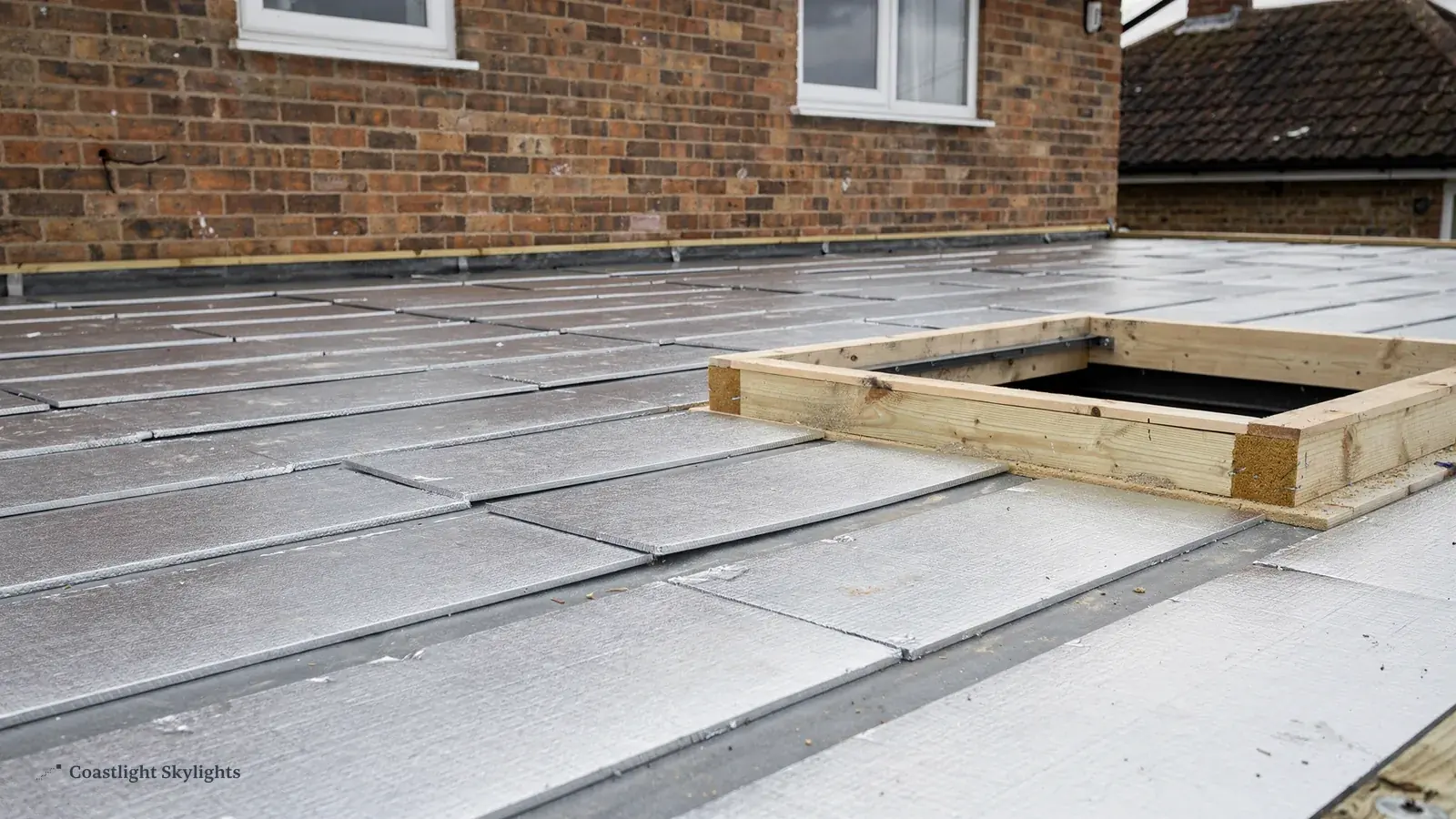
The covering is only the top layer. Underneath, a warm roof has insulation above the deck, which means the kerb needs to rise through the insulation and the upstand is formed over it. A cold roof has insulation between the joists and a ventilated void, which means we have to avoid blocking that airflow when the opening is trimmed.
Either way, forming an opening in a roof involves trimming the structure around it. Joists or rafters are cut and supported by new trimmers, and that is building work. The structure, weathering, fire performance and energy standards are all part of the Building Regulations picture, and on a notifiable job the Building Control notification comes from us. A new flat rooflight in an existing roof needs to meet 2.2 W/m²K.
Mixing old and new coverings
A frequent question is whether a new rooflight can sit in a roof covered with one material while the kerb is made from another. The answer is yes, because the kerb is only the mounting. What matters is that the covering you have is joined to the kerb with a method that suits the covering. Timber kerbs are usually wrapped in the roof's own membrane. Prefabricated kerbs supplied with the rooflight are treated in the same way, and the kerb material is chosen so that the membrane bonds to it properly.
What does cause trouble is a membrane that has been over-coated with a liquid product, a roof with moisture trapped in the layers, or a deck that moves. These are things we raise in the survey, not after the opening has been cut.
Getting materials up and old coverings down
Brighton and Hove has plenty of flat roofs that are hard to reach: rear additions in tall terraces, roofs behind parapets, flat tops over basements and roofs that can only be reached through the house. Rolls of felt, sheets of EPDM and drums of resin all have to be brought up and stored safely, and old covering has to come down.
That is why every quote includes a written access plan. On a flat roof it records how the crew will get up, be that scaffold across the garden, a street-side tower or a mobile platform, and who applies for any scaffold licence or parking suspension. We make those applications ourselves. For a converted building, it also covers whether the freeholder's consent is needed, and our guide to flats and leasehold buildings explains the usual position.
Planning and the roof you already have
The covering does not change the planning position. A house may be able to add a rooflight under permitted development, while permitted development does not reach a flat, which needs a planning application, and some conservation areas in Brighton & Hove are covered by Article 4 directions. Our planning guide sets out the questions to ask the council before you commit.
What the survey checks on your roof
- Identify the covering. We confirm whether it is felt, EPDM, GRP or a mixture, and note its age and condition around the opening.
- Look under the surface. Where we can, we check the deck, insulation type and joist direction, because those decide how the opening is trimmed.
- Measure the upstand space. We check parapets, abutting walls and gutters so that the kerb and cill have room.
- Agree the tie-in method. The quote states how the kerb will be joined to your covering and whether any extra roof area is included.
- Plan the access. The route to the roof, licences and Building Control are written into the access plan before any date is fixed.
Replacing a rooflight on an existing kerb
Not every job involves a new opening. If you already have a rooflight and it has failed or misted, the covering around the old kerb tells us how much work is involved. A sound upstand in good condition may take a replacement unit with minimal disturbance to the roof. A kerb that has rotted, or a covering that has lifted from it, has to be rebuilt. Our page on misted and failed rooflights explains how a failed sealed unit is assessed and replaced, and replacing a whole unit like for like counts as building work that must meet current Part L.
Roof covering questions we hear at the survey
Can a rooflight be fitted to any flat roof covering?
Yes, provided the existing covering is sound enough to join to. Felt, EPDM and GRP each have a proper method for dressing the kerb. If the covering is failing around the opening, the quote includes renewing that area.
Will the whole roof need replacing?
Not necessarily. Often only the area around the kerb is reworked. If the covering is worn out or cannot be bonded to, the written quote shows a larger area so you can see the choice before work starts.
Does the rooflight come with the kerb?
Some do and some are fitted on a kerb built on site. We choose the arrangement that suits your roof and your covering, and the quote lists it.
Do I need to tell anyone before work starts?
That depends on the building. Houses may be able to add a rooflight without a planning application, flats cannot, and Building Control is notified where the work is notifiable. For a leasehold flat, the lease may require the freeholder's written consent. The access plan sets out each of these.
Is a flat rooflight on a felt roof any less watertight than one on EPDM or GRP?
The material is less important than the detail. A well formed kerb, a covering joined to it with the right method and a rooflight with sound flashing will perform on any of the three.
For the wider picture, return to our flat roof rooflights page, or use the quote form to arrange a free survey, where we confirm what your roof is made of and how the rooflight will be tied into it.