The short answer: Yes, when the unit is specified for the use it will get and fitted properly. A walk-on rooflight is made from several laminated layers of toughened glass, set in a frame that carries the load into the structure around it. The risk is rarely the glass. It is a unit chosen for the wrong load, a weak upstand or kerb, or a surface that is slippery when wet. The survey checks all three before you get a fixed written quote.
People ask whether are walk on rooflights safe because standing on a skylight over a room feels wrong. That instinct is sensible, and it is the reason these units are designed so carefully. The full picture sits on our walk-on rooflights hub. This page answers the safety question on its own.
What a walk-on rooflight is made of
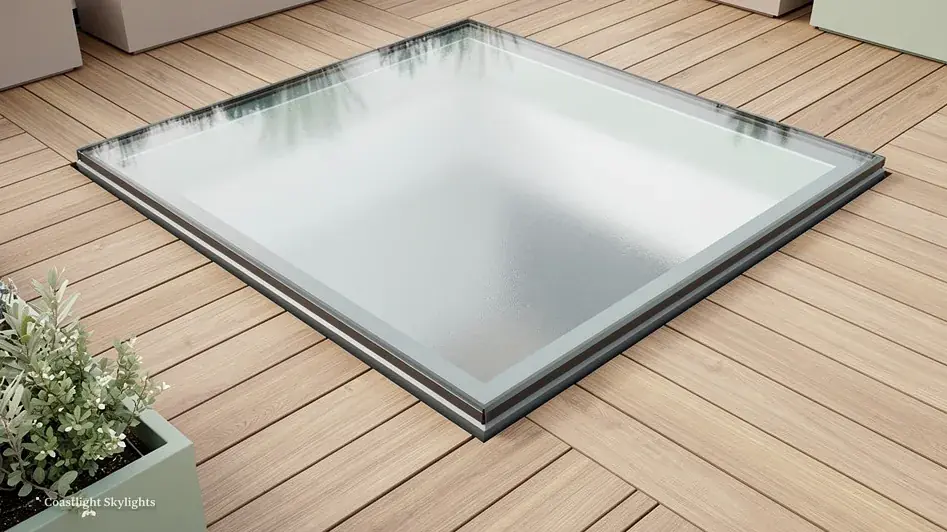
A walk-on unit is not a stronger version of a normal rooflight pane. It is built differently. Several sheets of toughened glass are bonded together with interlayers, so the panes work as one thick plate. If the top sheet is damaged, the sheets below are still there to carry a person. That layered build is what lets a unit be treated as a floor rather than a window.
The glass sits in a frame, and the frame sits on a kerb, upstand or supporting structure. The glass gets the attention, but the support does half the work. A fine pane on a poorly formed kerb is not a safe floor.
Safe for what, exactly?
Safety is always tied to a stated use. A pane sized for occasional foot traffic during maintenance is a different product from one meant for a family crossing a terrace every day, and different again from one that must take furniture and a group of people. When we survey, we ask what will happen on the glass, who will use it, and whether anything heavy will ever stand on it.
The glass maker publishes the rated load for each build-up, and the specification we write for your roof names it. If a quote ever described a unit only as "walk-on" without saying what it is rated for, that is the gap to ask about. Our page on loads and glass specifications explains how those ratings are read.
The three things that go wrong
When a walk-on rooflight causes trouble, it is almost always one of these.
- The wrong rating for the use. A unit meant for light access is asked to behave like a terrace floor.
- A weak support. The kerb is out of level, the timber is soft or the upstand is too thin to take the frame.
- Slip. Smooth glass is slick with a film of water on it, especially after sea mist.
None of these is a flaw in walk-on glass as a product. Each is a decision made at the survey and installation stage, which is where we spend the effort.
Slip is the everyday risk
Anyone who walks across a rooflight is testing its grip long before its strength. Clear glass wet with condensation or drizzle is slippery underfoot, and a terrace in Brighton & Hove gets plenty of damp air. A treated surface, such as fine etching or a ceramic frit pattern, adds grip without changing the strength. We go through the choices on the anti-slip glass page, and the wet question has its own answer on whether walk-on rooflights are slippery when wet.
Who should not stand on it
This is the part of the safety question that gets least attention. A roof can hold a mix of glazing, and from above they can look alike. Dirt, moss and weathering hide the differences, so a pane that looks sturdy may be a standard sealed unit made only to keep weather out.
Walk-on glass is made to be walked on. A normal rooflight is not. Anyone who steps onto an ordinary rooflight, even briefly, risks going through it, and that is a serious fall into a room. If you are not sure which type a roof has, treat it as not walkable and ask us before anyone goes near it. We cover that in more detail on standing on a normal rooflight.
Safe installation is part of the product
A rooflight over a room is a hole in a structure. Cutting it can mean trimming joists or rafters, and the new opening has to carry load, stay watertight and meet current rules. The work is controlled under the Building Regulations, and for a walk-on unit that is notifiable the Building Control notification is ours to send. What that covers is set out in our Building Regulations guide.
Access matters too. Getting large laminated panes to a roof is a heavy job. Every quote includes a written access plan, which records how the crew reaches the roof, who handles any scaffold licence or parking bay suspension, and how the glass will be lifted into place. Planning is separate. If the rooflight sits in a flat, a conservation area or a listed building, the planning guide shows what to check first.
Questions to ask before you buy
- What load is this exact unit rated for, and does that match how the glass will be used?
- What is the glass surface treatment, and how does it behave when wet?
- What carries the frame, and has someone looked at it?
- Is the work notifiable, and who handles that?
- Who is responsible if something is wrong afterwards?
On the last point, our work carries a 10-year workmanship guarantee, written into the quote. The guarantee page shows what it covers.
For the wider view of where these units go and how they are chosen, return to the walk-on rooflights hub, or arrange a free survey, where we inspect your roof, name the rating you need and give you a fixed written quote.