The short answer: Plain clear glass is slippery when wet, and a walk-on rooflight without a surface treatment will be too. The fix is a grip finish on the top pane: etching, a ceramic frit pattern or a fine textured coating. With one of those specified, a walk-on rooflight gives a dependable footing in rain, sea mist and condensation, though no glass is as grippy as decking.
A walk on rooflight (a walk-on skylight, in everyday speech) slippery after rain is a fair worry, and one worth settling before the glass is ordered. Wet toughened glass has very little friction, and a terrace near the coast spends a good part of the year damp. The wider picture of how these units are built is on the walk-on rooflights hub. This page deals with the surface alone.
Why glass gets slippery
Glass is hard, flat and non-porous. Water spreads across it as a thin film, and that film sits between the sole of a shoe and the surface. Wet leaves, algae and the salt residue left behind by sea air make it worse. Bare feet and smooth soles are the least forgiving.
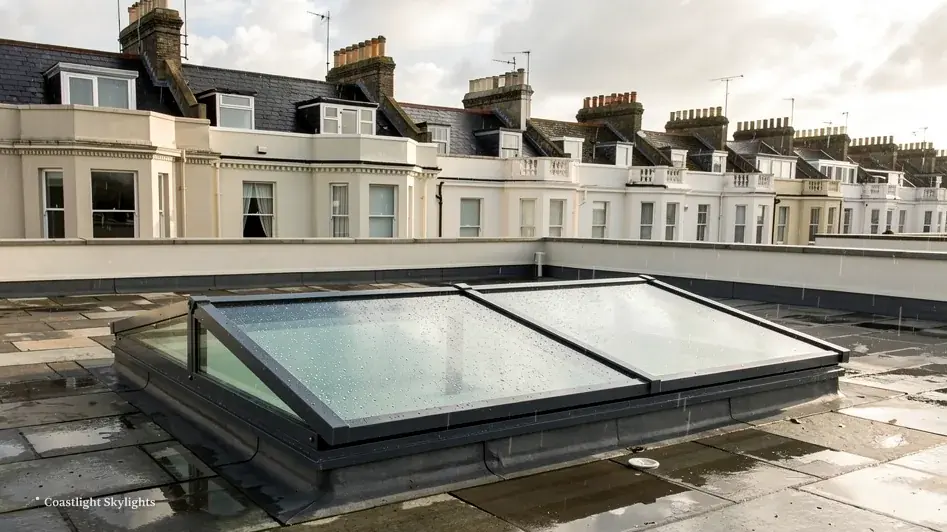
The same glass can feel quite different through the day. Dry at noon, it can be slick by early morning, once dew or overnight damp has settled on it. A slope makes it more pronounced, which is why a rooflight set into a pitched or falling terrace needs more thought than one set into a level floor.
What gives walk-on glass its grip
There are three approaches, and each leaves the strength of the glass unchanged. The load rating comes from the laminated build-up underneath, not from the finish on top.
- Acid etching. The top surface is lightly roughened, which looks frosted and gives a soft, even texture.
- Ceramic frit. A pattern of fine dots or lines is fired onto the glass. The raised pattern grips the sole, and the clear gaps between keep some of the daylight.
- Textured coatings. A fine grit finish applied to the surface, usually the most visibly grippy.
Each has a trade-off between grip, how much light passes through and how easy the glass is to keep clean. We lay the options out in detail on the page about anti-slip glass for walk-on rooflights.
How you will notice the difference
A frit pattern is easy to spot, because you can see the dots from above and feel them through your soles. Etched glass looks like pale frosted glass and is smooth to the hand but not to the shoe. Fine grit coatings are the most obvious, and some people find them rough on bare feet.
The finish also changes the view. A denser pattern gives more grip and takes more light from the room below. A lighter finish passes more daylight but gives less grip. That balance is the choice we talk through at the survey, because it depends on whether the rooflight is on a route or off to one side.
Where the risk is highest
- Terraces and balconies that stay damp because they get little sun.
- Rooflights that form part of a walking route, rather than sitting off to one side.
- Sloping surfaces, where a small loss of grip carries a person further.
- Courtyard and basement lightwell covers, where the glass is the only level surface. Our page on walk-on rooflights over basements and lightwells goes into those.
If the glass sits to one side, say a small rooflight in a corner no one crosses, a lighter finish is often enough. If it is part of the path to a door, specify more grip.
Slip is a separate question from strength
A pane can be rated to carry a heavy load and still be slippery, and a lightly loaded pane can have excellent grip. When you compare quotes, check that both the load and the surface finish are stated, not one or the other. Our answer on whether walk-on rooflights are safe sets the two side by side. Read more on ratings on the loads and glass page.
Keeping the surface working
A grip finish is only as good as the glass beneath it is clean. Sea air carries salt, and a terrace collects pollen, dust and bird droppings. Left alone, they build into a film that hides the pattern and takes the grip with it. A soft brush, clean water and a mild washing-up liquid are enough. Pressure washers and abrasive pads are not, since they can scratch the glass and wear down a coating.
Check the drainage around the frame too. Water that sits against the glass for days grows algae at the edge first, and that green slick spreads inward. A terrace that falls gently away from the rooflight keeps the surface drier, which helps more than any coating. We look at the falls on the day of the survey, because a small correction to the surrounding floor is far easier before the new unit goes in than after it.
If you are replacing an older unit that has become slippery, the finish on it may have worn or been cleaned away over the years. A new walk-on rooflight is specified with its grip treatment from the start, so you are not relying on whatever the old pane happened to have.
What we put in writing
Your quote names the glass build-up, the load rating and the grip finish for that unit. The survey also looks at the finished level around the frame, since a kerb that holds water makes any surface worse. Any Building Control notice a walk-on unit needs is filed by us, as covered in the Building Regulations guide, and every job begins with an access plan so the glass arrives on the roof safely. The result carries a 10-year workmanship guarantee.
For the full range of walk-on options, go back to the walk-on rooflights hub. If you would like a unit specified for your own roof, book a free survey.