Anti slip walk on glass is the surface treatment that makes a glass floor safe to cross in wet shoes, bare feet or leaf-covered boots. A walk-on rooflight, or walk-on skylight, is built to carry a person, but strength and grip are two different questions. This page covers the second one: what the treatments are, how they behave in a Brighton & Hove climate, and how to choose between them. For the wider picture of loads, frames and where these units go, start with our walk-on rooflights hub.
Why smooth glass is not enough
Clear toughened glass is hard, flat and very slippery once it has a film of water on it. Dry, it feels fine underfoot. After a sea mist, a shower or a night of condensation, it behaves more like a wet tile floor. Salt in the air leaves a faint residue that dries on the surface and then dissolves again on the next damp morning, so the glass changes its feel through the day.
That matters most where the rooflight is part of a route. A rooflight in a courtyard, a terrace or a flat roof access path is walked across daily, often by people carrying something. A pane that sits out of the way and is only stepped on for maintenance can get away with a lighter treatment. The right choice depends on how the glass will really be used, not on what the catalogue says is standard.
Anti-slip treatment is not what carries the load. The load rating comes from the build-up of laminated panes, which we cover on the loads and glass specifications page. The treatment is applied to the top surface to add grip, but some finishes slightly reduce the strength of the pane they sit on, so the finish is chosen before the glass is designed, not added afterwards.
The main anti-slip treatments
There are three common ways to give a walk-on pane grip. Each leaves a different look and each behaves differently when it gets dirty.
Ceramic frit patterns
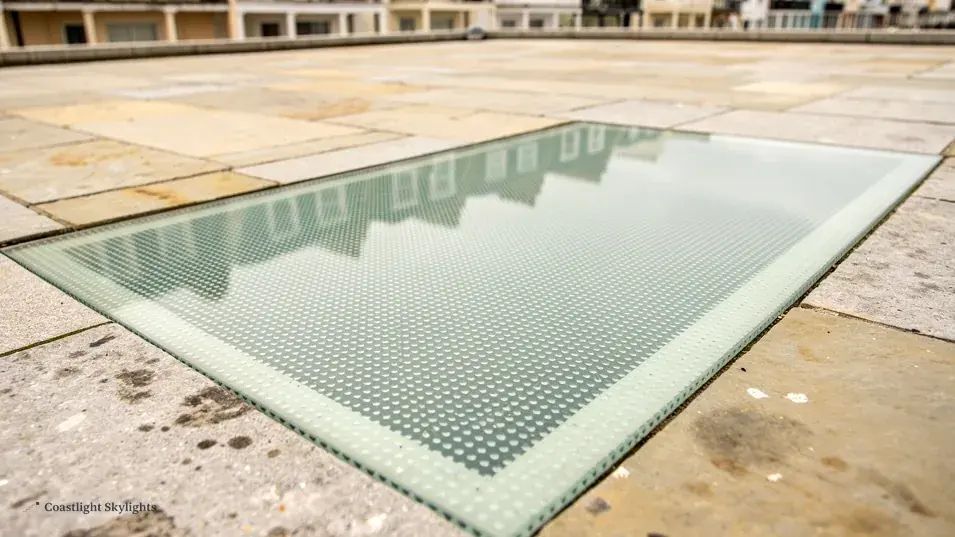
A frit is a ceramic enamel printed onto the glass and then fired into the surface when the pane is toughened. It becomes part of the glass and is hard-wearing, though years of grit underfoot will still dull it slowly. The usual pattern is a field of small dots, but lines and grids are available too. The dots stand a fraction proud of the glass and give the sole something to bite on.
Frit can be clear, white, grey or tinted. A denser pattern gives more grip and also more privacy, because it breaks up the view through the pane. A sparse pattern keeps the glass open and bright but gives a little less bite.
Acid etching
Acid etching frosts the surface of the glass in a controlled way. It gives a soft satin finish that feels slightly rough under the hand. It is quiet to look at and sits well with period buildings. Grip is good rather than strong, and the finish can show oily marks more than a printed pattern does.
Sandblasting
Sandblasting cuts a coarse texture into the glass with abrasive. It can be applied as an overall finish or as a pattern, such as a band across the walking area. It gives a very positive grip but a rougher feel, and in a pattern it is the most visible of the three treatments. It also collects dirt in the texture more readily, which suits some places and not others.
| Treatment | Look | Grip | Cleaning |
|---|---|---|---|
| Ceramic frit | Dots or lines, many colours | Strong, part of the glass | Easy, wipes clean |
| Acid etch | Soft satin frost | Good | Shows oily marks |
| Sandblast | Coarse, patterned or overall | Very strong | Holds dirt in texture |
Some suppliers also offer a clear anti-slip film or coating. A separate coating sits on the glass rather than in it, and it wears under foot traffic. We would not treat it as a permanent solution for a pane that is crossed every day.
How grip is measured
You do not have to take a supplier's word for grip. Slip resistance of a floor surface is commonly tested with a pendulum, in which a rubber slider swings across the surface wet and the drag is recorded. Glass makers put their treated panes through this kind of test and publish the result as a rating. Ask for the test result for the exact pattern you are being offered, because a dense dot field and a sparse one from the same maker will not score the same.
A rating on its own does not tell you how the glass will feel in the shoes you wear. Smooth leather soles, wet rubber and bare feet all react differently to the same finish. For a family terrace, we tend to look at the rating and then at a physical sample, held under a running tap and stepped on.
If the pane sits on a route that other people use, such as a shared roof terrace in a converted building, the freeholder or managing agent may have their own view. The lease side is dealt with under flat and leasehold rooflights.
Choosing a pattern for how the glass will be used
We start with the question of who walks there and how often. The answer usually points to one of a few situations.
A terrace or roof garden path
Glass that forms part of a terrace is walked on daily and is wet whenever the weather is. Choose a pattern with positive grip, such as a denser frit. If the terrace is also a place for bare feet and small children, ask to feel a sample first. Our page on walk-on rooflights for roof terraces and balconies goes into the surrounding build-up.
A courtyard, basement or lightwell
Glass at ground level over a lightwell collects leaves, grit and bird droppings, and it sits in the shade where algae can grow. The glass here wants a pattern that is easy to sweep and rinse. Frit is usually the better partner than a deep sandblast. The detail of these installations has its own page: walk-on rooflights over basements and lightwells.
A maintenance walkway on a flat roof
Where a pane is part of a service route to plant or a hatch, grip matters even though foot traffic is light, because the person crossing it may be carrying tools. A clear frit pattern keeps the glass working as a rooflight while giving the necessary bite.
Looks, light and privacy
Every anti-slip finish takes a little clarity from the glass. A fine pattern reads from below as a faint texture. A coarse one reads as a pattern in its own right. In a basement or a dark ground-floor room, the pattern changes the way daylight falls across the floor beneath, and the finish you pick is going to be visible every day from the room side too.
It also changes privacy. A dense frit makes a pane much harder to see through from above, which suits a rooflight set into a terrace overlooked by the neighbours. A sparse frit and a light etch leave the pane nearly clear. If privacy is the reason you are considering a pattern, tell the surveyor so that the choice serves both purposes.
Colour deserves a sample too. A white frit on a bright day can glare, while grey sits quieter against stone paving. Looking at the sample outside, next to your actual paving or decking, is more useful than looking at it on a desk.
Keeping the surface working
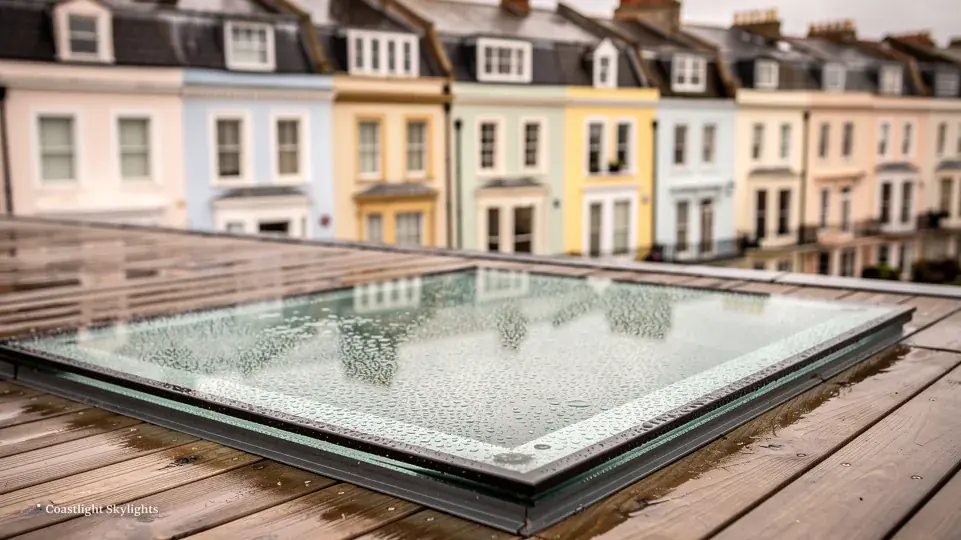
An anti-slip pattern keeps working only if it stays clean. Algae, moss and a film of grime fill the gaps between the dots and the glass slowly goes back to behaving like a smooth pane. That is a maintenance question rather than a failure of the glass.
- Sweep leaves and grit off regularly, especially in autumn.
- Wash with warm water and a mild detergent and a soft brush. Avoid abrasive pads and strong chemicals, which can damage seals and dull the finish.
- Do not use a pressure washer close to the frame or the edge seals.
- Keep planters and furniture off the glass unless the specification allows it, and use pads under any item that does stand there.
If a pane begins to look worn, cloudy between the layers or damp inside, that is a different problem. A failed sealed unit is replaced rather than cleaned, and the misted and failed rooflights page explains how to tell.
Anti-slip glass and the rest of the specification
The grip finish is one line in a longer specification. A walk-on rooflight in a flat roof is a rooflight in the Building Regulations sense, so a new or replacement unit must meet the 2.2 W/m²K limit for rooflights, and the glazing build-up has to deliver that alongside the load rating. Extra laminated layers for strength add weight and thickness, and the frit has to be specified so that it does not interfere with the thermal performance. The Building Regulations guide sets out what applies, and any Building Control notice the walk-on unit needs is filed by us.
If the rooflight is being fitted into a roof that has no opening at present, the structure around it matters too. Trimming the joists, forming a kerb and checking the fall of the roof are all part of the job. The surface treatment is added to a pane that has to fit that structure, so we settle the framing first and the finish last.
Planning is a separate question. A walk-on rooflight in a house roof may fall within permitted development, but a flat has no such rights, and a conservation area can carry an Article 4 direction. Our planning guide explains how to check with the council before you commit.
Samples, survey and getting the choice right
The quickest route to the right finish is a sample and a visit. At the free survey we measure the opening, look at how the glass will be reached and talk through who will walk on it. The finish is then written into the fixed quote with the glass build-up, so there is nothing left to guess.
- Survey. We look at the roof or floor, the route people will take across the glass and the conditions it faces: shade, trees, sea air.
- Sample. You see and handle the pattern options, ideally wet, and you choose against your own paving or decking.
- Specification. The finish, the glass build-up and the frame go on one page of the written quote.
- Access plan. The quote includes the access plan: the route to the roof, the scaffold licence we apply for and the notice to neighbours.
- Fitting. The unit is installed to current Building Regulations and the glass is cleaned and handed over with a note on care.
Installation sits under our 10-year workmanship guarantee. What affects the price is the size of the pane, the number of laminated layers, the frame and the access, not usually the choice between frit and etch. If you want to understand that split before you ask for a visit, read how much a walk-on rooflight costs and our costs overview.
Questions that come up about grip
Will it be slippery when wet?
A treated pane with a proper pattern is far less slippery than clear glass, but no hard surface is slip proof. We have a separate page on this: are walk-on rooflights slippery when wet?
Can I add grip to glass that is already there?
A pattern fired into the glass has to be done at manufacture, so existing panes cannot take a ceramic frit afterwards. If the glass is a poor fit for how you now use it, the honest route is to look at replacing the unit, and the survey is where that is assessed.
Is a normal rooflight ever fine to stand on?
No. Ordinary rooflight glass is not rated for foot loads, whatever the finish. The page on standing on a normal rooflight explains why, and are walk-on rooflights safe? covers the safety side.
Choosing the grip finish is a small decision with a daily consequence. If you would like a sample and a free survey, ask for a quote, or return to the walk-on rooflights hub for the other options.