The short answer: roof lantern cost depends on five things more than on the lantern itself: its size and frame, the upstand or kerb it sits on, the state of the flat roof around it, how we get materials and people up to that roof, and the paperwork the job needs. In Brighton and Hove the access part can move the figure as much as the glass does, because a terrace with no rear entry may need a scaffold licence or a parking bay suspension. The free survey gives you a fixed written quote, with every one of those costs set out in writing before you commit.
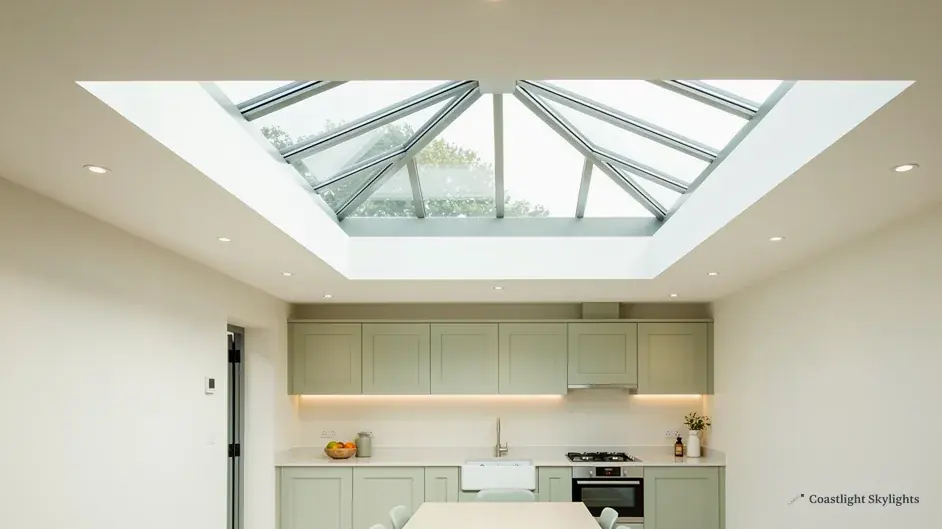
A roof lantern is the most built-up kind of skylight, almost a small building in its own right: an aluminium or timber frame, sealed glazed units, a ridge, hips, a kerb and a weathered junction with the roof it sits on. Each of those parts can be simple or awkward on your particular house, and that is why two lanterns of the same catalogue size can be quoted very differently. This page explains what goes into the number, so the quote you receive makes sense line by line. For the wider picture on design, glazing and fitting, start with our roof lanterns page.
The lantern itself: size, frame and glass
The unit is the part people expect to pay for, and it is the easiest part to understand. A larger lantern needs more glass, longer bars and a heavier frame, and above a certain span the glass gets thicker and the frame sections deeper to carry the weight and resist wind. Proportion matters as much as raw size. A long, narrow lantern over a galley kitchen uses its materials differently from a square one over a dining space, and our guide to roof lantern sizes and proportions covers how to get the scale right for the room below.
Frame material is the next decision. Powder-coated aluminium is slim and needs little upkeep. Timber, usually with an aluminium capping outside, suits period houses and some conservation settings but takes more work to make and finish. We compare the two in aluminium or timber roof lanterns. Colour also plays a part: a standard RAL finish is one thing, a dual colour with a different shade inside and out is another.
Glass specification changes the figure too. Every lantern we fit meets the Part L limit of 2.2 W/m²K for a rooflight in an existing home, but you can go further with solar control coatings for a south-facing extension, self-cleaning outer panes, or acoustic laminated glass under a flight path or a busy road. Each option adds cost and each one is a choice, not a requirement. Opening vents, manual or electric, and rain sensors sit in the same category.
What sits under it: kerb, opening and structure
A lantern never sits directly on a roof deck. It needs an upstand, sometimes called a kerb, that lifts the frame clear of standing water and gives the roof covering something to turn up against. That kerb might be a factory-made insulated unit or a timber one built on site, and the right choice depends on the roof build-up and the height you want the lantern to sit at. Our page on roof lantern upstands and kerbs goes into the detail.
If the opening already exists, for example where an old lantern or a flat polycarbonate dome is being replaced, the structural work may be small. If the opening is new, joists have to be cut and trimmed, and the trimmers sized so the roof still carries its load. That is building work, and Building Control will want to see how the structure has been dealt with. A new opening in a flat roof also means making good the ceiling below, plastering the reveals and sometimes moving a light fitting or a run of cable.
Taking out an entire lantern and fitting an identical one is notifiable too, and Part L applies to the new unit. For a notifiable lantern job we make the Building Control notification, whether the local authority or a registered building control approver handles it, and its cost sits inside the quote rather than arriving later. The Building Regulations guide explains what is checked.
The roof around it
This is the part of a lantern quote that surprises people. The lantern can only be as watertight as the roof it is fixed into. If the flat roof is a tired felt covering with blisters, ponding or soft decking, fixing a new lantern into it is poor value, because the junction will be the first thing to suffer when the old covering fails. In that case the survey will say so plainly, and the quote may include stripping and recovering part or all of the roof in a membrane that can be properly dressed up the kerb.
Where the roof is sound, the cost is in forming a clean upstand detail, fitting lead or membrane flashings, and leaving falls that carry water away from the lantern rather than towards it. Parapet walls, valley gutters between neighbouring extensions and boxed outlets all add detail to that work. If you have had trouble with an old unit, our page on whether roof lanterns leak explains where water usually gets in and why the junction matters more than the glass.
Getting to the roof in Brighton and Hove
On a detached house with a side gate, getting a lantern onto a single-storey extension is straightforward. Brighton and Hove has a lot of housing that is not like that. Long Victorian and Edwardian terraces often have no rear access at all, so every frame, glazed unit, roll of membrane and length of timber comes through the house or over it. Steep streets, permit-only parking and narrow pavements make it harder still.
The route to the roof is decided at the survey, and it shapes the cost directly. A short rear scaffold built through the garden is one option. A tower or a full scaffold from the street is another, and if it stands on the pavement or road it needs a scaffold licence from the highway authority. If the delivery or a hoist needs space at the kerb, a parking bay suspension may be needed as well. We apply for both, and the licence costs, the scaffold hire and any suspension sit in the written figure. The council sets its own fees and timescales; how the application runs is covered in our scaffold licence guide.
Converted houses and flats add another layer. If the lantern is going onto a roof that belongs to the freeholder, you will usually need their written consent, often called a licence for alterations, before any work starts. Neighbours may need notice where the scaffold crosses a shared path or a party wall is involved. The quote records this, and the leasehold rooflight guide walks through the steps. Always check your own lease.
Permissions that can affect the figure
Class C permitted development often covers a house lantern, provided it meets the conditions, among them a 150 mm limit on how far it projects from the roof plane. How those conditions apply to a lantern on your particular roof is something to confirm early, before anything is ordered. Permitted development does not extend to flats, so a flat needs planning permission. If the building is listed, listed building consent is also required. Some conservation areas in the city are covered by Article 4 directions, and the council is the place to check. Where an application is needed, the drawings and the fee are a real cost, and the quote will say whether your job needs them. Our planning guide for Brighton and Hove and the page on planning permission for a roof lantern cover this in more depth.
How the written quote lays it out
Every quote we send includes the access plan, a page that shows how the job will actually happen on your roof. That is where the hidden costs of a lantern stop being hidden. It covers:
- the route to the roof, whether a garden scaffold, a street tower or a mobile platform
- the scaffold licence and any bay suspension, applied for by us
- freeholder consent and the notice to neighbours, where your building needs them
- the Building Control route for your job
- the price, as one fixed figure
Alongside it you get the lantern specification, the kerb and roof work, and the making good inside. Our 10-year workmanship guarantee covers the installation. If you want to weigh the cost against what you get back in daylight and use of the room, our page on whether roof lanterns are worth it is a useful next read, and the costs page explains how we price across all our rooflight work.
The only honest roof lantern cost is the one that comes from looking at your roof. Book a free survey and we will come out, measure up, check the route in and send you a fixed written figure. You can also go back to the roof lanterns page to look at styles and options first.