The short answer: A well-made lantern, set correctly on a sound upstand and weathered properly, should not leak. When one does, the cause is usually where the lantern meets the roof, or a failed seal, rather than the glass itself. A leaking lantern needs a proper assessment, and the answer is often a new, correctly detailed unit.
If you are asking whether roof lanterns, a kind of skylight, leak, you are probably either planning one or looking at a stain on a ceiling. Both are fair reasons. This page explains where water gets in and what should be there to stop it. For the full range, see our roof lanterns hub.
Where a lantern can let water in
The glass panels are not usually the problem. The weak points are the joints, and a lantern has several.
- The junction between the lantern base and the upstand it sits on.
- The upstand itself, and how the roof covering is dressed up and over it.
- The joints between glazing bars and ridge, especially at the corners of a hipped lantern.
- The seals around each glass unit.
- Any fixing that passes through the weathering.
Water follows gravity and wind. It finds the lowest gap that is open to the weather, then travels inside the structure and shows up somewhere unexpected, often several metres from the entry point.
The upstand is where it is won or lost
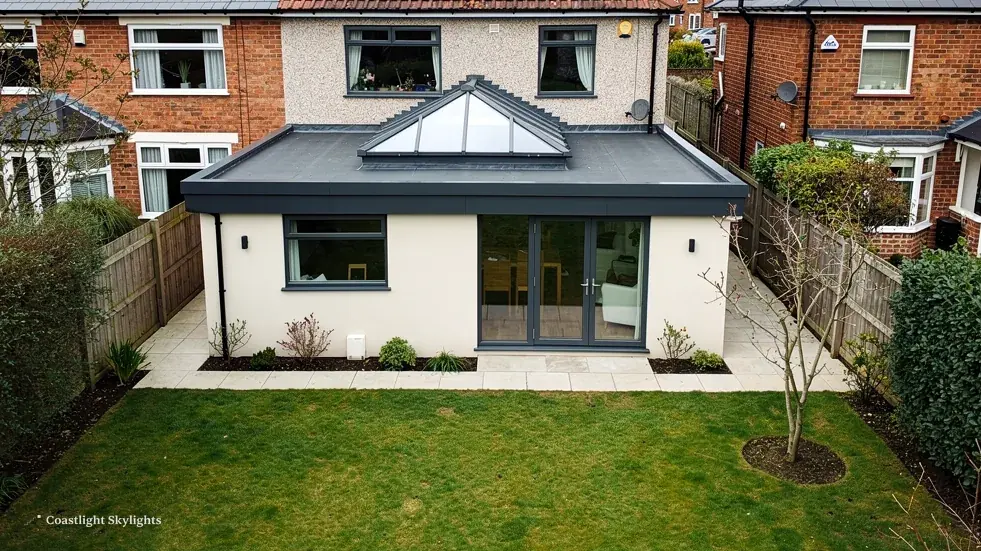
A lantern needs a kerb or upstand to sit on, so that the waterproof layer of the flat roof can rise above the level of any standing water. If the upstand is too low, or the felt, EPDM or GRP covering is not taken up and finished with a proper flashing, water can be driven under the lantern base in heavy rain. Our page on roof lantern upstands and kerbs explains the heights and the detail.
The roof beneath the kerb matters too. A flat roof needs falls so that water runs to the outlet rather than pooling against the lantern. Ponding against an upstand is a quiet cause of trouble for years before anyone notices.
Condensation and a leak are not the same
Owners who find water inside a lantern often assume the roof has failed. Condensation forms when warm, damp air meets a cold surface. A kitchen lantern collects it on cold mornings, and it runs down the inside of the glass and drips from the bars. That is a ventilation and glass question, not necessarily a weathering failure.
The way to tell is to look at when it happens. Water that appears only after rain, and appears at the corners or the base, points to a leak. Moisture on cold, dry mornings points to condensation. A trapped, permanent fog between the panes of a sealed unit is a third thing: the seal has gone and that unit has failed. The answer for a failed sealed unit is replacement, as set out on our page for misted and failed rooflights.
What causes leaks on older lanterns
Lanterns installed without enough thought for the roof under them tend to show the same patterns as they age. Sealant joints dry out and open. Frames flex slightly with temperature, and older gaskets lose their grip. Timber lanterns can show movement at the joints if the finish has worn. A lantern fitted on a low kerb may be fine for years, then meet a storm and a blocked outlet at the same time.
When a lantern has a fault like this, the sensible step is to find out what is actually wrong before deciding anything. Sealant alone, on a lantern with structural movement or a poor upstand, only hides the issue for a season. The honest assessment looks at the glazing, the upstand, the falls and the age of the unit together.
How we deal with a lantern that is failing
We install and replace lanterns. The survey is free, and we look at the lantern, the kerb and the roof around it. If the lantern is the problem, the answer is a replacement unit sized to the opening and correctly weathered onto a sound upstand. If the upstand is wrong, we correct it as part of the same job.
If a leaking lantern has to come out and be replaced as a complete unit, that is building work, so it is notifiable and must meet Part L at 2.2 W/m²K for rooflights. The Building Control notice is ours to submit, and more is in the Building Regulations guide. The fixed written quote also includes the access plan, so you know how we reach the roof and who arranges any scaffold licence. A 10-year workmanship guarantee applies as well, described on our guarantee page.
Getting it right if you are buying new
If you are still choosing a lantern, you can avoid the problem at the design stage. Ask who is responsible for the upstand and the weathering as well as the glazing. Check the lantern suits the pitch and falls of the roof. Consider whether the material suits your house: our comparison of aluminium or timber roof lanterns helps with that. And think about whether a lantern is the right shape at all. A flat unit has fewer joints, as the page on roof lantern or flat rooflight explains.
A lantern is a small building on your roof, and it needs the same care in detailing as any other part of the building envelope. Done well, it stays dry and quiet for a very long time.
What to note before the survey
You can help the assessment by writing down a few observations. Note which wind direction and how heavy the rain was when water appeared, which corner of the room it showed in, and whether the stain has grown. Take photographs of the ceiling and, if you can reach the roof safely from a window, the base of the lantern. Do not climb onto a flat roof to inspect it yourself. Our surveyor will reach it using the route set out in the access plan, and will check the upstand, the falls and the outlet properly.
Go back to the roof lanterns hub, or request a no-charge survey and we will assess the lantern on site with you.