Every quote, brochure and data sheet for a rooflight or skylight carries a figure with the unit W/m²K. That figure is the U-value, and it tells you how quickly heat escapes through the unit. The rooflight U-value is the number the Building Regulations care about, and it is the one worth understanding before you compare products. This guide explains what it measures, what the rules ask for, and why two units with similar glass can give different results. It belongs with our main page on energy efficient rooflights.

What a U-value measures
A U-value is the rate at which heat passes through one square metre of a structure when the air on either side differs by one degree. It is written W/m²K, watts per square metre per kelvin. You do not need to do the arithmetic. You need to know the direction of travel: a lower number means less heat escapes.
A wall, a floor, a window and a rooflight each have their own U-value. A rooflight is usually the weakest point in an insulated roof, because glass lets heat out far more easily than an insulated roof build-up does. That is why the figure matters, and why a roof with one large glazed lantern can lose more heat through that lantern than through the entire rest of the ceiling.
What the Building Regulations ask for
Part L of the Building Regulations sets limits for new and replacement fittings in existing homes. The limits differ by type of unit.
- Roof windows set in a pitched roof: Window Energy Rating band B, or 1.4 W/m²K. Conservation rooflights fall into this group.
- Rooflights on flat roofs, and lanterns: 2.2 W/m²K.
The rules apply when you fit a new unit or replace a whole one. Putting new glass alone into a sound frame is not a controlled fitting under Approved Document L, but a like-for-like unit replacement is building work and has to meet the limit. When the U-value work is notifiable, we send the Building Control notice, either to the local authority's Building Control service or to a registered building control approver. The Building Regulations explainer gives the full picture.
If you want the plain answer to the question in a few lines, our page on what U-value a rooflight needs sets it out.
Why the limits are different
A pitched roof window and a flat roof rooflight are built in different ways. A roof window is a complete window with a frame, a sash and a sealed unit, and it is tested as a whole window. A flat roof rooflight is usually a glazed dome or a flat glass unit on a kerb, which behaves differently and is tested and rated differently. The regulations reflect that. Neither is wrong, and the same house can reasonably have both.
It also explains why you cannot just choose the lowest number and compare it across types. A figure for a roof window and a figure for a flat rooflight are not the same measurement, so compare like with like.
Centre-pane or whole unit
This is the point that catches people out. Some brochures quote the centre-pane U-value. That is the performance of the glass in the middle, away from the edges. A whole-unit figure includes the frame and the spacer bar around the edge of the glass, both of which lose more heat than the middle of the pane does.
The whole-unit figure is usually the less flattering of the two, and it is the one that reflects how the rooflight really performs in your roof. Regulations are written around the whole unit, so that is the figure to ask for. If a quote gives only a centre-pane number, ask what the whole-unit number is.
What decides the number
The glass
Double glazing traps a layer of gas between two panes. A low-emissivity coating on one pane reflects heat back into the room. Triple glazing adds a third pane and a second gap. Each addition lowers the U-value, but each also adds weight and cost, which is why our page on whether triple glazing is worth it exists. A guide to the options is in double or triple glazed rooflights.
The spacer
The spacer bar holds the panes apart and runs round the edge of the glass. A metal spacer conducts heat. A warm edge spacer does not. Switching to a warm edge spacer lowers the U-value of the whole unit and also reduces the cold edge where condensation first appears. We explain it in what is a warm edge spacer.
The frame
A frame in aluminium loses more heat than one with a thermal break or one made from PVC-U or timber. On a small rooflight the frame is a large share of the unit, so the choice matters more than people expect.
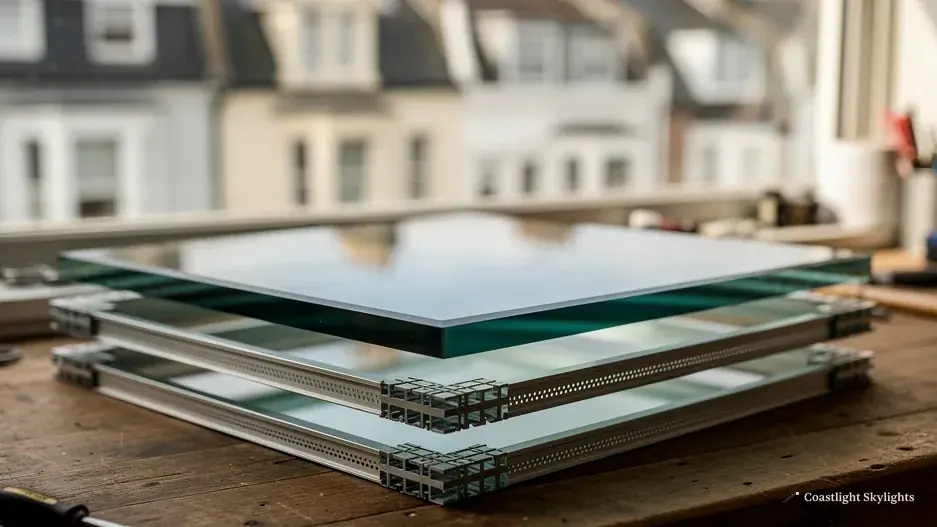
| Part of the unit | Lowers heat loss | Raises heat loss |
|---|---|---|
| Glass | Extra pane, low-e coating, gas fill | Single pane, uncoated glass |
| Spacer | Warm edge spacer | Plain metal spacer |
| Frame | Thermal break, insulated kerb | Uninsulated metal frame |
| Seals | Tight gaskets that close squarely | Worn or distorted seals |
A worked example, without the sums
Take a kitchen extension at the back of a terrace with a flat roof and one large rooflight over the dining table. The roof around it is well insulated. The rooflight is the one place where the insulation stops and the glass starts. On a cold January evening, that glass is the coldest surface in the room, and it is where the warm, moist air from cooking meets it first.
Now picture the same room with a unit that has a better glass build-up, a warm edge spacer and an insulated kerb. The glass is still the coldest surface, but the gap in temperature is smaller. Less heat leaves, the inner surface stays warmer, and condensation forms less readily. None of it needs a calculator. It is the same room, with the same heating, and a rooflight that gives less away.
The reverse is true as well. If an old single glazed or early double glazed unit is still in place, the saving from replacing it with a modern one makes a real difference to that ceiling, because the glazed opening is the weakest part of the roof.
The kerb and the seal count too
The rooflight sits on something. On a flat roof that is a kerb, a raised upstand of timber or insulated material that the rooflight is bolted to. If the kerb is uninsulated, heat travels straight round the unit and through the upstand, and the quoted figure for the glass no longer tells the story.
Likewise the seal. The best glazing in the world does little if cold air finds its way through a poorly fitted gasket or an opening sash that does not close squarely. If your unit opens, our page on electric and opening rooflights explains how opening units are built to close tight.
U-value is not the whole story
A low U-value stops heat leaving. It does not stop heat arriving. In summer a south-facing rooflight can let in more heat than you want, and a low U-value does not change that. Solar control glass handles the incoming heat, and some of its coatings slightly reduce the light that passes through. Our guide to solar control glass for south-facing rooflights and our answer on whether rooflights overheat in summer cover that side.
The same goes for the cold. A rooflight with a good U-value still feels cooler than an insulated ceiling, because glass is glass. Whether it makes a room cold is a different question, and do rooflights make a room cold answers it.
Condensation is also linked to the U-value. A warmer inner surface is less likely to attract moisture. If the issue you have is dampness on the glass, read reducing condensation on rooflights.
Window Energy Rating, in short
For roof windows the regulations give you a second route to compliance. Instead of a single U-value, a roof window can meet the standard by reaching Window Energy Rating band B. The rating weighs heat lost through the window against useful heat gained from the sun, so a window with slightly higher heat loss but good solar gain can still reach the band.
That is helpful, but it only applies to roof windows. A flat roof rooflight or lantern is judged on its U-value alone. If a supplier quotes a band for a flat rooflight, ask what the U-value is as well, since the U-value is what the rule for that type uses.
Reading a quote or a data sheet
- Find the figure and check the unit is W/m²K.
- Check whether it is for the whole unit or the centre of the glass.
- Check which type it covers: roof window or flat rooflight.
- Compare it against the Part L limit: 1.4 for roof windows or band B, and 2.2 for rooflights.
- Look at the spacer, the glazing and the frame material behind the number.
Our quotes name each of these so you can see where the figure comes from. If you hold a quote from another source and do not recognise the numbers, send us the details and we will explain what each line means.
Conservation areas, listed buildings and the limit
Some rooflights have to look a certain way. A conservation rooflight sits flush in the roof and has a slim metal frame, and meeting the roof window limit with a slim profile takes careful specification. Our page on conservation rooflights explains the style.
A house in a conservation area keeps its rooflight rights as they were. What removes them is an Article 4 direction, or else a planning condition, and since many of the city's conservation areas fall under such directions, ask the council before you order. A flat has no permitted development rights, and a listed building needs listed building consent in addition. The Brighton and Hove planning guide sets this out.
How a replacement gets on the roof
The U-value is only half the job. The other half is getting a new unit onto a tall, narrow or permit-only street without trouble. Our access plan is a written page in every quote. It records how we reach the roof, which party puts in for the scaffold licence and any bay suspension (we do), what the neighbours are told, the Building Control route and the price. The licensing page has the details.
In a converted building, the roof usually belongs to the freeholder, and a leaseholder normally needs written consent before replacing a rooflight. Check your lease, and read rooflights in flats and leasehold buildings.
When a failed unit needs replacing
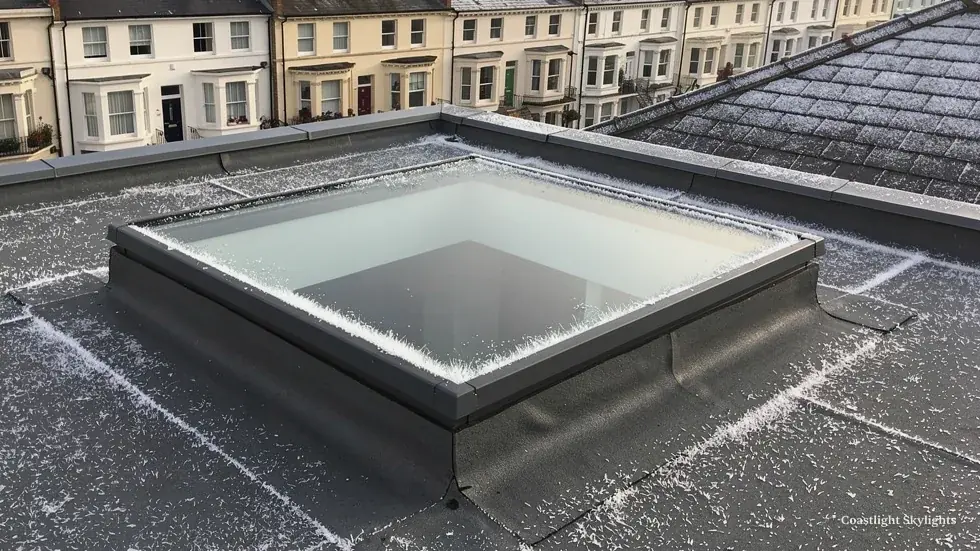
A sealed unit that has misted has let in moist air and may have lost some of its gas fill, and with it some of its insulating value. The fog between the panes means the seal has failed, and the unit cannot be restored. Its U-value is no longer the figure on the label. We assess it and replace it with a unit that meets the limit. See misted and failed rooflights.
What the survey gives you
A free survey tells you what is on your roof, what type each unit is, and which limit applies. We then give you a fixed written quote naming the glass, the spacer, the frame and the whole-unit figure. What changes the price is the size, the glazing level, the frame, the roof type and how hard the roof is to reach. See costs for the general picture. Our workmanship guarantee lasts 10 years, and the cover is spelled out on the guarantee page.
For more on glazing and heat, go back to energy efficient rooflights, or book your free survey.