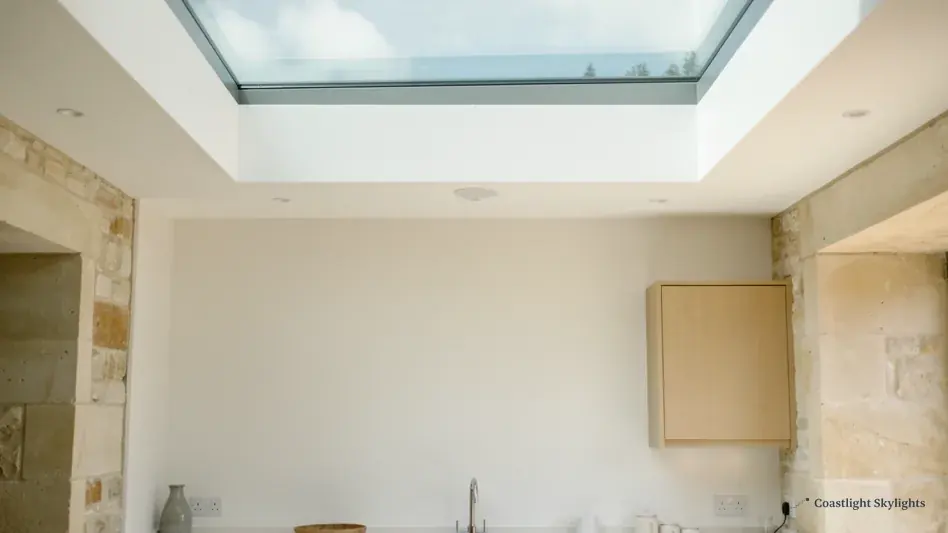
A rooflight, or skylight, faces the sky, so on a bright afternoon it takes more sun than any wall window in the same house. Solar control glass for a rooflight is a coated pane that lets daylight in but turns away a good part of the sun's heat, and on a south or west-facing roof it can be the difference between a room you use in July and one you avoid. This page explains how the glass works, what it changes about the room, and when other measures do more. It supports our energy efficient rooflights page.
Why a rooflight gets so hot
Sunlight arrives at a wall window at a slant, and the eaves, a tree or the house opposite often shade it. A flat or low-pitched rooflight sees the sun almost square on for much of the day, with nothing in the way. The heat comes through as shortwave radiation, warms the floor, furniture and walls, and then stays in the room because warm air rises and collects right under the glass.
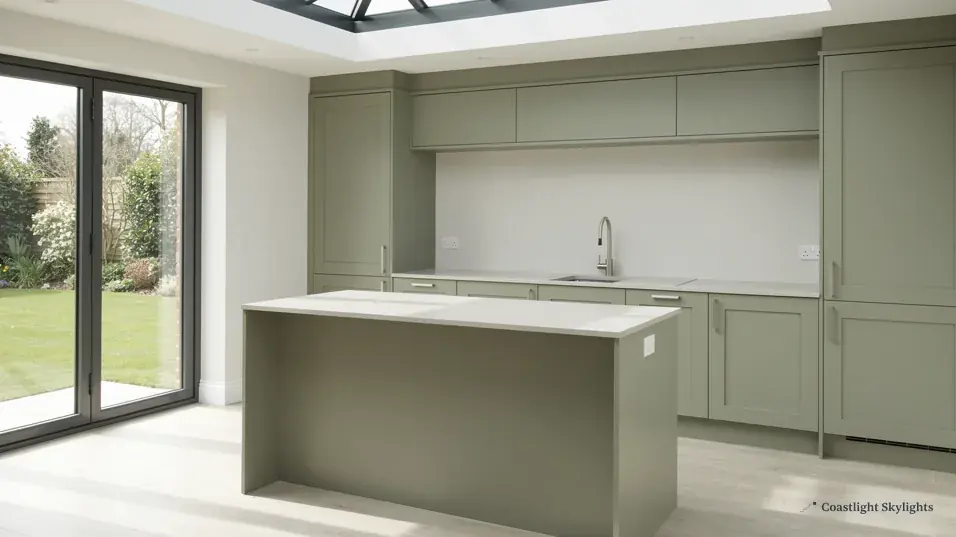
A kitchen extension with a big flat roof rooflight or a lantern over a south-facing garden is the classic case. The glass area is large, the room is a box under it, and the ventilation may be limited to one door. A loft room with a roof window on a south slope behaves the same way, and it has the extra problem that the roof structure above is hot as well. We look at the broader question in do rooflights overheat in summer.
How solar control glass works
Standard glazing in a modern sealed unit is built to keep heat in. Its low emissivity coating reflects the long-wave heat from inside the room back towards you. It is deliberately open to the sun, because in winter a little free solar warmth is welcome.
Solar control glass does something different. A second coating, applied to the outer pane or in the cavity, reflects or absorbs a share of the sun's incoming energy before it reaches the room. The figure that describes this is the g-value, the proportion of the sun's energy that passes through the glass. A lower g-value means less solar heat gets in. The thermal coating still does its job as well, so the unit keeps the U-value you need for Part L while also cutting solar gain.
There are two things to separate in your mind. The U-value is about heat leaving. The g-value is about heat arriving. Our page on rooflight U-values explained deals with the first. This page is about the second.
What you see and what you lose
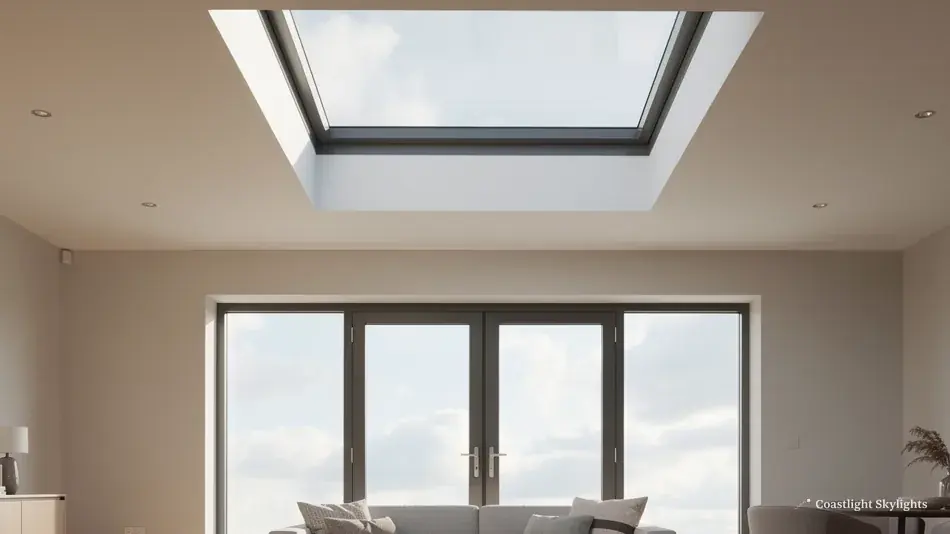
Modern solar control glass is far less obvious than the heavily tinted or mirrored glass of the past. Looking up through it from inside, you see a very slight cool or neutral tone, and from outside the rooflight can look a touch more reflective than ordinary glass. Some coatings are close to clear. Others give a more noticeable tint.
The cost is daylight. Any coating that stops heat stops a little light with it. A solar control rooflight over a deep room will feel slightly less bright than a clear one, and the effect is greater with stronger coatings. On a north-facing roof that never gets direct sun, you gain very little and lose light, which is the wrong trade. That is why we do not fit it on every job.
There is also a winter effect. Because less solar warmth enters, a room with solar control glass collects less free heat on a clear cold day. For a room used mainly in summer, such as a garden room or a conservatory-style extension, that is fine. For a living space that you heat for most of the year, you are swapping a summer problem for a small winter cost, and you should decide with your eyes open.
| Roof situation | Solar control glass? | Reason |
|---|---|---|
| South-facing lantern over a kitchen | Usually yes | Large glass area, sun all day |
| West-facing roof window in a loft room | Often yes | Low evening sun, hot bedroom |
| North-facing flat rooflight | Rarely | Little sun to turn away |
| Rooflight in a shaded light well | Rarely | Walls and neighbours do the shading |
| Sun tunnel on a south slope | Seldom needed | Small dome, little glass area |
Is it a solar control glass rooflight or a blind?
This is the practical question, and the answer is that they do different jobs. Glass is fixed. It works every day, including the dull ones when you would like all the light you can get. A blind is adjustable, so you only pay for shade when you want it.
External blinds and shutters beat internal ones for heat, because the sun is stopped before it passes through the glass. An internal blind absorbs the energy after it has entered the room and then releases it as warmth. Where a rooflight has an external blind option, it is the most effective single measure for a very hot roof. Where it does not, solar control glass is the better route, since it works whether or not anyone remembers to close the blind.
Many good installations use both: solar control glass as the baseline, and a blind for the hottest weeks. A lantern is the harder case, because an external blind on a faceted roof is difficult to fit and to manage, and the glass does most of the work.
Choosing the strength of the coating
Solar control coatings come in grades. A light grade keeps the glass close to clear and trims the heat a little. A stronger grade turns away more sun and darkens the room more. There is no best grade, only the right one for the roof in front of you.
We think about it in terms of the room below. A lantern over an open plan kitchen with white walls has plenty of reflected light inside, so a stronger coating costs little in brightness. A narrow loft room with dark slopes and one roof window has very little to spare, so a lighter grade is kinder. Where a rooflight is the only daylight source for a windowless bathroom or hallway, we lean towards the clearest glass that still meets Part L, and we deal with heat by other means.
Ask to see a sample pane against the sky when we survey. A coating looks different on a sample held up in your hand than in a data sheet, and you are the one who lives under it.
Opening the rooflight helps as well
Glass lowers the heat that enters. Ventilation carries away what does get in. A rooflight that opens is a very effective vent, because the hottest air gathers at the highest point and leaves through the opening while cooler air is drawn in lower down. A motorised rooflight with a rain sensor lets you leave it ajar safely. The options are covered on electric and opening rooflights.
So the combination that suits a hot south-facing extension is often a fixed or opening unit with solar control glass, plus a way to let air through. If you have a fixed lantern over a room with no cross breeze, consider whether an opening panel could be added, because glass alone cannot cure a stuffy space.
Solar control and the other glazing choices
Solar control is a coating choice, separate from the number of panes. You can have it on a double unit or a triple one. A triple glazed unit lowers solar gain slightly just because there is more glass in the path, but the effect is not a replacement for a proper coating. Our page on double or triple glazed rooflights goes through how the number of panes affects weight, thickness and light.
The warm edge spacer, the gas fill and the frame all stay the same as on any good unit. If you want to know why the edge detail matters to the overall figure, the answer is on what is a warm edge spacer.
Fitting solar control glass in a Brighton and Hove roof
The city has plenty of roofs that suit it. Tall terraces with flat roofs behind a parapet often carry a single rooflight over a stair or a bathroom, and a rear extension with a flat roof tends to take most of the afternoon sun. Mansard roofs and converted attic flats put a roof window under a slope that heats up fast. In each case a solar control glass rooflight is a quiet change: the frame stays, the look from the street stays, and the room is easier to live in.
The difficulty is rarely the glass. It is reaching the roof. A parapet may leave no safe edge to work from, a rear garden may be too narrow for scaffold, and a steep street may need a permit bay suspended for a tower. We settle all of that before the day.
What the regulations say
Putting in a complete new rooflight or roof window of the same kind is building work, and it is notifiable, so the new unit has to satisfy Part L. In an existing dwelling a pitched-roof window must reach 1.4 W/m²K or Window Energy Rating band B, while the limit for a flat-roof rooflight or a lantern is 2.2 W/m²K. Solar control glass fits within those limits because the thermal coating that delivers the U-value stays in place. Where Building Control needs telling, we send the notification for the replacement unit. The detail is in our Building Regulations guide, and the numbers are worked through under what U-value does a rooflight need.
There is a separate part of the regulations, Part O, that deals with overheating. It applies to new homes, not to extensions or to work on an existing house, so a replacement rooflight or a lantern on an extension is not assessed under it. That does not make the heat any less real, which is why we still weigh the glass against the aspect on the survey.
Replacing glass that has failed
If your existing rooflight has misted, the seal has failed and moisture is trapped between the panes. That unit cannot be repaired. The decision at that point is a good moment to look at the glass specification, because you are replacing it anyway. A south-facing room that always ran too hot is the one to ask about. How we assess one is covered under misted and failed rooflights.
A glass-only swap inside a healthy frame is not treated as a controlled fitting, though the frame must be able to take the new glazing. Not every older frame can. The survey tells you which route applies.
The survey and the practical side
On the free survey we note which way the roof faces, how much of the day it is in direct sun, the size of the glass, how the room is used and what ventilation it has. From that we recommend whether solar control glass is worth fitting, and we tell you plainly if it is not. The quote then carries a fixed written figure. What shifts the price is set out on the costs page.
The access plan is a written page in every quote. It records the way onto the roof, who arranges a scaffold licence or a suspended bay if one is needed (we do), whether a freeholder's consent is needed in a converted building, the Building Control route and the price. More is on the access plan. A rooflight in a flat raises a further point, covered under rooflights in flats and leasehold buildings: the freeholder normally owns the roof and your lease may call for their written consent.
Changing the glass on a rooflight usually does not alter how it looks from the street, but a new opening is a different matter, and conservation areas, Article 4 directions and listed buildings can change the rules. See the planning permission guide. Our 10-year workmanship guarantee applies to the finished work, and our guarantee page has the terms.
Common questions we hear on site
Will it make the room dark?
A little less bright, yes, and more so with stronger coatings. On a south-facing roof with plenty of sun the room is still well lit. On a shaded roof the loss is easier to notice, which is why we advise against it there.
Will it stop condensation?
No. Solar control is about heat coming in, and condensation is about moisture and surface temperature. For that, read reducing condensation on rooflights.
Does it cool the room in winter?
It reduces solar warmth, but the thermal coating still keeps your own heat in. The room does not lose more heat than with ordinary glass. It simply gains a little less from the sun.
If your rooflight cooks the room, arrange a free survey and the glass, the aspect and the ventilation get assessed together. For the rest of the subject, return to the energy efficient rooflights hub.