The tube is the part of a sun tunnel nobody sees once it is fitted, and it decides most of what the finished hole in your ceiling looks like. The rigid vs flexible sun tunnel question is really a question about your roof, your ceiling and the space between them. This page walks through how each tube is made, where each one earns its place, and how we choose on a survey. It supports our sun tunnels in Brighton & Hove service, where the full range is set out.
What a sun tunnel is made of
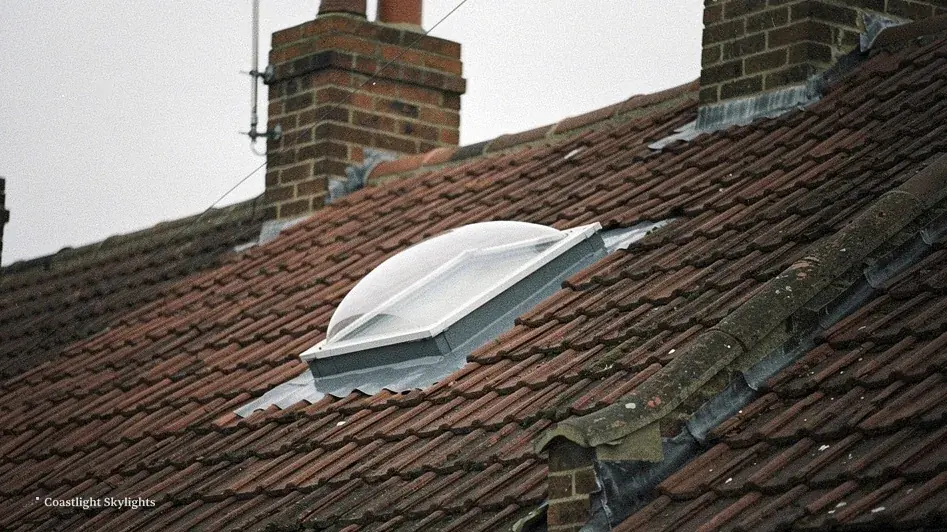
Every sun tunnel has three parts. At the top is a domed collector that sits on a flashing set into the roof. At the bottom is a diffuser, a frosted or prismatic panel fixed in the ceiling. Between them runs a tube with a reflective lining, and that tube is where rigid and flexible versions part company.
A skylight and a sun tunnel both bring daylight into a room, but they do it differently. A skylight is a window in the roof, so you see a patch of sky. A sun tunnel is a light pipe. It gathers daylight on the roof and carries it down a lined tube, so the room gets a bright ceiling fitting and no view. That makes it the tool for rooms where a roof window would not reach, such as a hallway under a loft, a landing or a bathroom with floor space above it.
The tube length, the number of bends and the lining all affect how much light arrives. The choice between a rigid tube and a flexible tube changes all three.
How a rigid tube works
A rigid sun tunnel uses straight sections of metal tube, usually aluminium with a polished mirror finish on the inside. The sections push together and are taped or clipped at the joints. Because the surface is smooth and highly reflective, light bounces down it with little loss. That is the main argument for rigid: for a given length, a straight rigid run delivers more light to the room than a ribbed flexible one.
Rigid tubes can also change direction. Angled elbow pieces let the tube step sideways around a rafter or a chimney breast, and the elbows can be adjusted to suit the pitch of the roof. Each elbow does cost some light, because the beam has to reflect more times, so fewer and gentler bends are better.
Where rigid makes sense
- A short, direct drop from roof to ceiling, where the tube can run almost vertical.
- A long run through a loft or a deep flat roof build-up, where you want to keep losses down.
- A ceiling that is easy to reach from above, so the joints can be made up neatly and checked.
- A property where the tube will be visible in a loft or cupboard and you want a tidy, solid finish.
Where rigid struggles
A rigid tube needs a clear path. If a purlin, a chimney flue, a water tank or an electrical run sits in the way, the sections have to be cut around it with elbows, and in a tight roof void there may be no room to turn a rigid section at all. Rigid sections also need space to be handled. In a loft that is already full of joists and bracing, getting a stiff tube in position can be harder than it looks on a drawing.
How a flexible tube works
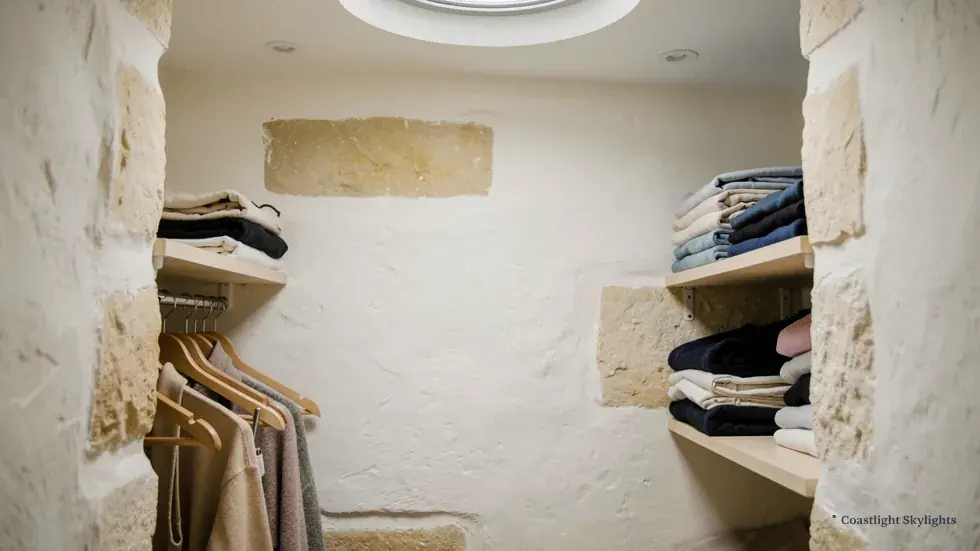
A flexible sun tunnel uses a ribbed, collapsible tube with a reflective foil lining. It arrives compressed and is pulled out to length on site. The ribs let it bend, so it can follow a curved route around obstacles, which a rigid tube cannot do without cut sections and elbows.
That flexibility is the whole case for it. In an older Brighton and Hove house, the roof void is rarely tidy. There are rafters that were cut and trimmed by earlier owners, old water pipes, ceiling joists at odd spacings and sometimes a purlin or a chimney stack in just the wrong place. A flexible tube can be eased round these without opening up more of the ceiling than necessary.
The cost of the ribs is light. The ridged surface scatters the beam more than a smooth mirror does, and every metre of tube and every bend loses a little more. The sensible way to use a flexible tube is to keep it short, keep it taut, and keep bends gentle. A tube that is left slack or kinked in the middle will deliver a dimmer room than the same tube pulled straight.
Where flexible makes sense
- A roof void with rafters, pipes or ductwork that rule out a straight line.
- A short route where the small loss from the ribbing hardly matters.
- A ceiling where the diffuser position is fixed by the room below, and the roof position is offset from it.
- A job where access to the loft is tight and a stiff tube could not be carried in.
Rigid vs flexible sun tunnel: the practical comparison
| Question | Rigid tube | Flexible tube |
|---|---|---|
| Light carried | Higher for the same length | Lower, and falls with length and bends |
| Straight run | The natural choice | Works, but pulled taut |
| Offset route | Needs elbows and space | Bends round obstacles |
| Cramped loft | Harder to handle | Easier to feed through |
| Appearance in the void | Neat and solid | Ribbed and softer |
Neither type is better in every house. A rigid tube suits the job where the geometry is simple, and a flexible tube suits the one where the loft is crowded. Plenty of installs use a flexible section for a short awkward stretch and a rigid section for the straight part, because a tube can be mixed if the product range allows it.
Length, bends and brightness
People often ask which tube is brighter, as if the answer were fixed. It is not. A short flexible tube pulled straight can outperform a long rigid tube with several elbows. What matters is the path the light takes.
Think of three things as you read a survey drawing. First, how far is it from the collector to the diffuser? Second, how many changes of direction does the tube have to make? Third, what is the quality of the lining along the way? A long tube with a lot of bends will always be dimmer than a short straight one, whichever material it uses.
If you want to know how far a tube can go before the light fades, our guide to how long a sun tunnel can be goes into length in more detail. For how performance holds up when the sky is grey, see whether sun tunnels work on cloudy days.
The roof and ceiling set the choice
The tube sits between two surfaces, and both change the answer. On the roof side, a pitched slate or tile roof and a flat roof take the same collector but a different flashing. On the ceiling side, the diffuser has to land where the room needs it, which is not always straight beneath the collector.
On a pitched roof the collector sits on the slope, so the tube leaves the roof at an angle and has to be brought back to vertical or to the ceiling position. A rigid angled elbow does this cleanly at the top, then a straight section drops down. On a flat roof the collector sits on a kerb or upstand, the tube drops almost straight, and rigid is often the simplest choice. Our page on sun tunnels on flat and pitched roofs covers how each roof type is detailed.
Brighton and Hove has a lot of tall terraces and converted houses with long, narrow roof voids. In those, a tube that has to pass a party-side wall plate or a cut-through for old services usually wants flexible. A parapet-edged flat roof on a terrace or rear extension, by contrast, can have a shallow, plain void under the deck, and where it does a short rigid tube drops through it cleanly.
Condensation, insulation and the tube
A sun tunnel is a cold tube passing through a warm house, so it needs to be treated like any other part of the roof build-up. Where the tube passes through an insulated loft or a cold void, the section between the roof and the ceiling is usually wrapped or lagged so that warm room air does not meet a cold surface and condense on it. A sealed diffuser at the ceiling also helps, because it stops warm moist air from the room getting into the tube.
Both tube types need this care. A flexible tube is lighter and sags more easily, so it should be supported along its run. A rigid tube is self-supporting but its metal skin is a good conductor, so the lagging matters. The diffuser and collector units themselves are sealed, and the sealed units are not something you open and clean from the inside, which is why the choice of unit and tube at the start matters more than anything done afterwards.
Because the tube needs an opening cut through the roof, it is building work, and Building Control checks the structure, weathering, fire and energy details. Where that applies, we send the notification for the sun tunnel. How it works is explained in our Building Regulations explainer covering skylights and rooflights.
What you see from the room
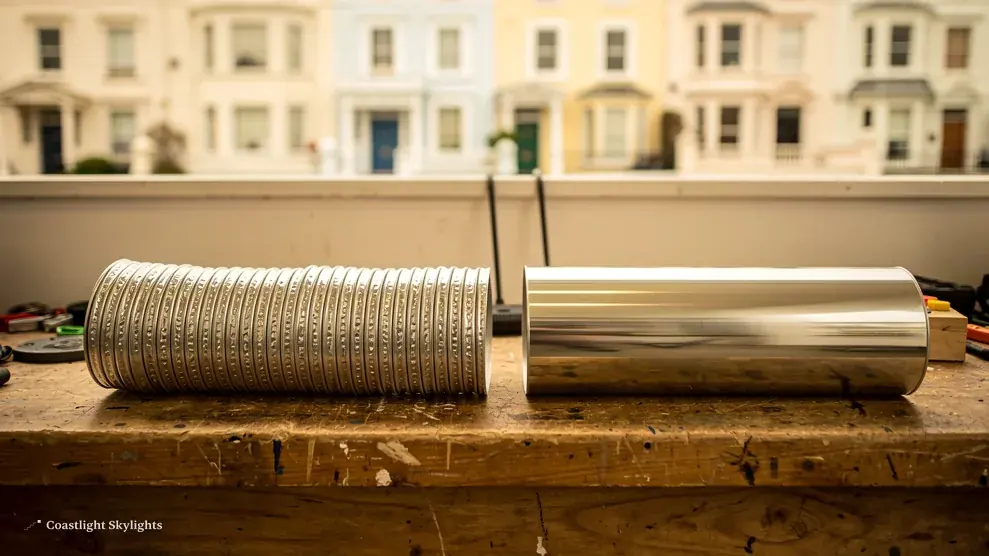
From below, a rigid and a flexible sun tunnel look the same. You see a round or square diffuser in the ceiling, set flush or slightly proud, and a clean trim ring. The tube above it is hidden. So the choice does not change how the room looks, only how well the tunnel performs and how neat the work in the roof void is.
Some diffusers are flat and frosted, and some are domed or prismatic. Some tunnels offer a light kit or a ventilation option in the same tube. If you want a tunnel that lights a bathroom and also moves air, say so on the survey, because that changes the product, not just the tube.
If you are thinking about where in the house the tunnel should go, our guide to sun tunnels for hallways, landings and bathrooms looks at the rooms that benefit most.
Flats and leasehold buildings
A top-floor flat in a split house usually sits under the freeholder's roof, and a flat has no permitted development right for a rooflight, so planning permission may also be needed. Check your lease, and expect to need the freeholder's written consent (a licence for alterations) before any opening is made. What to ask for is set out under rooflights in flats and leasehold buildings. For houses, the planning side is covered in our planning guide for rooflights in Brighton & Hove.
A flat often has the least space for a tube, because the void between the ceiling and the roof is small and shared. In that case a short flexible section may be the only route that fits, and the survey will say so plainly.
How we choose on a survey
We do not decide the tube type in advance. The free survey goes through a fixed order, and the choice falls out of what we find.
- Find the clear path. We look in the loft or void and trace the straightest route from the roof to the ceiling.
- Count the obstacles. Joists, pipes, ductwork, wiring and any chimney stack are marked, so we know how many bends the route needs.
- Check the roof covering. Slate, tile or flat roof membrane decides the flashing and where the collector can sit.
- Pick the tube. A straight run gets rigid. A crowded one gets flexible, or a mixed run if that is the neatest answer.
- Write it down. The route, the product and the fixed price go into the written quote, and the roof access goes onto the page we call the access plan.
The access plan sets out how we reach the roof, whether a scaffold or a tower is needed, and who applies for any highway licence. If the work needs a scaffold on the pavement, we apply for it, as covered on our page about scaffold licences and parking suspensions.
Questions to ask before you commit
- How many bends will the tube need, and where are they?
- Is the route straight enough for a rigid tube, or does something force a curve?
- Will any section run through a cold void that needs lagging?
- Where will the diffuser sit in the ceiling, and does it match the room layout?
- Does the roof covering change the flashing or the collector position?
If the answers point to a clean, straight drop, rigid is usually the better choice. If they point to a crowded void, flexible is. If you are still weighing whether a tunnel is the right product at all, our page on whether sun tunnels are worth it sets out the case, and for the details of what happens on the day, read how a sun tunnel is installed.
When a tunnel is not the right product, a roof window or a flat roof rooflight may be. We cover those under roof windows and flat roof rooflights.
Guarantee and next step
Every sun tunnel we fit carries a 10-year workmanship guarantee on our installation, whichever tube goes in it. Details are on our guarantee page. Costs depend on the tube, the roof and the access, and the survey gives a fixed written figure, so you can compare before you decide. For the factors, see how much a sun tunnel costs.
Back to the main sun tunnels page, or request a free survey, so we can inspect your loft and say which tube it suits.