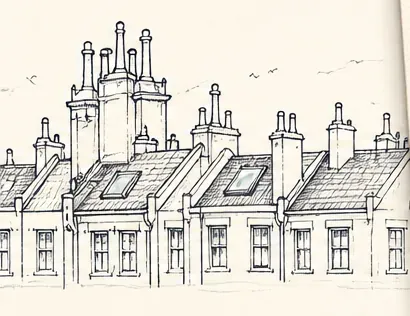
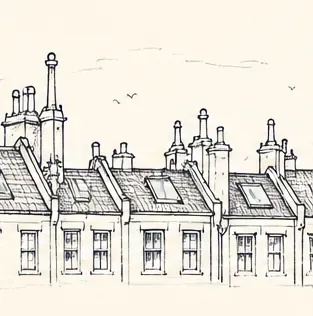
The short answer: In everyday use there is no difference. Both words mean a glazed opening in a roof that lets daylight in. Homeowners say skylight, and the roofing trade says rooflight. The trade does use the word more precisely, though: a rooflight usually means a unit on a flat or low-pitched roof, while a roof window is the opening unit set into a pitched slope.
If you are comparing quotes and one firm writes skylight while another writes rooflight, you are almost certainly being offered the same sort of thing. The words only matter once you start choosing a product, because the product names tell you how the unit is built and which standard it must meet. The main Brighton and Hove page lists everything we fit.

Where the two words came from
Skylight is the older, plainer word. It describes what the thing does: it lets the sky into a room. It is the word you will hear on the phone and see in a search box. Callers who ask about a skylight are describing exactly the same product a catalogue lists as a rooflight, and we answer them in the same way.
Rooflight is the word used on drawings, in manufacturers' catalogues and in the building rules. It sounds more technical because it is. It covers a wide family of products, from a fixed pane over a stairwell to a large lantern over a kitchen extension. When a planner or Building Control officer writes about your project, rooflight is the word you will see.
Neither word is wrong. We use both on this site because both are used by the people who find it.
The products behind the words
The more useful distinction is between the types of unit. These are the ones you are likely to meet.
| Unit | Roof | Typical room |
|---|---|---|
| Roof window | Pitched | Loft rooms, landings, attic bedrooms |
| Flat roof rooflight | Flat | Kitchens, extensions, hallways |
| Roof lantern | Flat | A raised glazed feature over a larger room |
| Walk-on rooflight | Flat or ground level | Daylight through a terrace or floor into a space below |
| Sun tunnel | Pitched or flat | Small, dark rooms with no wall to the outside |
A roof window sits in the plane of a pitched slope, usually opens on a centre pivot or a top hinge, and is the picture that comes to mind when somebody says skylight. A VELUX window is one brand of roof window, and people often use the brand name as a general word. A flat roof rooflight is generally a fixed or opening unit on an upstand or kerb, and a roof lantern is the taller, multi-sided version.
Why the difference affects the rules
Here the words do matter, because the Building Regulations treat the two groups differently. In an existing home, any new or replacement roof window set into a pitched slope has to achieve 1.4 W/m²K, or Window Energy Rating band B. A rooflight on a flat roof, or a lantern, must reach 2.2 W/m²K. A conservation rooflight in a pitched roof is classed with roof windows for this purpose.
The regulations simply set a separate figure for each group, so the first job is to know which group your unit belongs to. Our Building Regulations guide goes through the figures in more detail.
Planning is simpler. For a house, Class C permitted development covers rooflights of every type provided they stay within the stated conditions. Flats have no such rights, and listed buildings need listed building consent in addition. Read the planning guide before you commit to a position on the roof.
Extra choices once you know the type
Within each family there are options that change how the unit behaves. You can have a fixed unit or one that opens. An opening unit can be hand operated or electric, with rain sensors on some models. Glass can be specified for better thermal performance, which is the focus of our energy efficient rooflights. On older properties, a conservation rooflight has a slim, low-profile frame that sits close to the roof and suits sensitive buildings.
None of these choices needs you to learn trade vocabulary. If you tell us the room, the roof and what you want from it, we match it to the right unit and say so in writing.
A word on sun tunnels and walk-on glass
Two products sit slightly outside the usual picture. A sun tunnel is a small domed collector on the roof joined to a diffuser in the ceiling by a tube, and it brings light into a landing, cupboard or bathroom where a full window would not fit. A walk-on rooflight is glazing strong enough to stand on, set into a terrace, flat roof or floor so that daylight reaches the room below. Both are called skylights in casual use, and both are rooflights to the trade.
What to ask for in a quote
Because the words are loose, the quote is where to pin things down. A good quote names the exact type of unit, whether it opens, the size, and the glass specification. It should say who deals with the scaffold licence and the Building Control notification, and it should show a fixed price.
Ours include the access plan, a written page that sets out how the roof will be reached, who handles any licence, and what Building Control route applies. See the access plan for what is on it. Every job begins with a free survey, and the price we give afterwards is fixed and in writing.
Next steps
If you are still unsure what suits your roof, the guide to adding a skylight to an existing roof shows what is needed for a new opening. If you already have a unit that has failed, see the signs a rooflight needs replacing.
To arrange a survey, use the quote form or call 01273 282313. You can also return to the hub page to browse all the unit types.