The short answer: The clearest signs are condensation or fog trapped between the panes, water marks on the ceiling or reveal, a frame that is cracked, rotten or corroded, glass that is crazed or broken, and a unit that will no longer open and close. A sealed glazed unit that has failed cannot be dried out, so the answer is assessment and replacement. A survey confirms which part has gone.
Rooflights fail slowly, and the first signs are easy to put down to the weather. It helps to know what each symptom usually points to, so you can tell a cosmetic problem from one that needs a new unit. The wider range of work we do across Brighton and Hove is on the home page.
Mist between the panes
A modern rooflight or roof window uses sealed double or triple glazing. The panes are held apart by a spacer, and the gap is sealed at the edge. When that seal fails, moist air gets in and condenses on the inner faces of the glass. You see a cloudy haze, droplets or mineral streaks that you cannot wipe away, because they are inside the unit.
It is easy to confuse with condensation on the room side, which wipes off and is usually a ventilation matter. Mist that sits between the glass does not wipe and does not dry out. It tells you the seal has gone and the insulating value of the glazing has fallen with it. This is the classic case for replacing the sealed unit, and sometimes the whole rooflight when the frame is also tired. Our page on misted and failed rooflights covers it in detail.
Water coming in
A brown stain on the ceiling, a damp reveal or drips on a windy day all suggest water is getting past the unit. It does not always mean the rooflight itself is at fault, because the leak might come from a flashing, the roof covering or a gutter close by. The way to find out is to have it assessed with the roof in view.
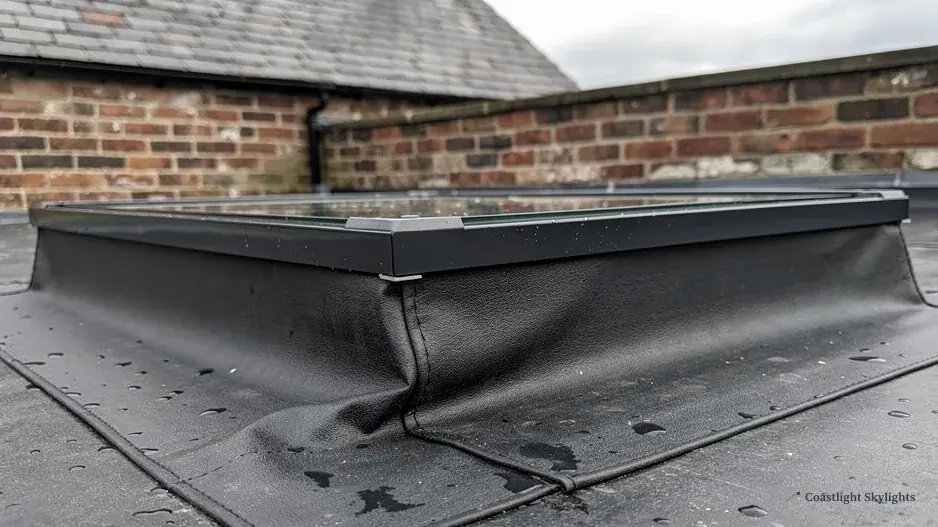
What matters is how old the unit and its surroundings are. On older flat roof rooflights, the upstand and the roof membrane often reach the end of their lives at the same time as the glass. On pitched roofs, flashing kits wear, and the frame of an older roof window can lose its seal. Where the unit and its weathering are both past their best, replacing the whole thing together is the dependable route.
Frames, glass and fittings
Look closely at the frame. Timber frames show soft, dark or flaking patches where moisture has sat. Metal frames show white powdery corrosion or paint lifting from the surface. Plastic frames can warp or crack, and on any frame a gap can open at the corner joints.
The glass tells its own story too.
- Cracks or chips in the outer pane, especially from a tile or branch strike, weaken the unit and let water into the sealed gap.
- Crazing, a fine web of small cracks, usually points to impact or thermal stress and is not something that clears.
- Scratched or yellowed plastic glazing on older domes and lanterns has lost its clarity, and may be brittle to the touch.
- Rusted or seized hinges, stays and operating arms stop an opening unit from closing against its seal.
An opening unit that no longer shuts properly will let in draughts and rain regardless of how good the glass is. If the unit is electric or opening, a motor that stalls or a rain sensor that no longer responds also points to the end of its service life.
Comfort and energy clues
Some signs show up in the room rather than on the roof. A room under an old rooflight that is noticeably colder in winter and hotter in summer than the rest of the house may be losing heat through poor glazing. Persistent condensation on the room-side pane can mean the unit is no longer insulating well. Older units are also single glazed in many cases, or have thin double glazing, and fall short of the current standard.
That standard is published. Whatever replaces a worn roof window in a pitched roof needs Window Energy Rating band B or 1.4 W/m²K, and a flat-roof rooflight or lantern needs 2.2 W/m²K. What better glazing looks like is shown under energy efficient rooflights.
What happens once you suspect a fault
Start with a free survey. We look at the unit, the frame, the kerb or flashing and the covering around it, and work out whether the glass alone has failed or the whole unit needs to go. Fresh glass alone in a frame in good order falls outside the controlled fitting rules, whereas swapping the entire rooflight or roof window for an equivalent is building work and is notifiable. The Building Regulations guide covers both cases.
You then get a fixed written quote. It includes the access plan, which sets out how the roof will be reached and who arranges any scaffold licence or parking suspension. The detail is on the access plan page. If the replacement is notifiable, the Building Control notice is ours to send, and our workmanship guarantee on the new unit runs for 10 years.
If you live in a flat, check your lease first, since the roof is normally the freeholder's. The consent that is usually needed is explained under flat and leasehold rooflights.
Next steps
Do not wait for a stain to spread. Take a clear photo of the unit from inside, note the date the signs first appeared, and send them with your enquiry. If you are wondering whether to change the type of unit while it is out, the difference between a skylight and a rooflight is a good place to read first, and who installs skylights and rooflights covers how to compare quotes.
To book a survey, use the quote form or call 01273 282313. The hub page lists every unit we fit.