If you need to replace a plastic dome rooflight, you are probably looking at a skylight in the form of a bubble of acrylic or polycarbonate on a flat roof that has gone yellow, cracked or cloudy. These domes were fitted to a great many kitchens, bathrooms, landings and rear extensions, and they have a limited life. This page explains why they age, what a replacement involves and what you can put in their place. It belongs to our wider guide to misted and failed rooflights in Brighton and Hove.
What a plastic dome rooflight is
A dome rooflight is a moulded plastic bubble, single, double or triple skinned, held in a frame that sits on a kerb on a flat roof. The kerb is a short upstand, built from timber or a moulded section, that lifts the dome above the roof covering so that water runs around it rather than into it. The dome clips or screws to a frame, and the frame is flashed into the roof membrane.
Domes are light, cheap to make and easy to fit, which is why they spread. They are also made of a material that reacts to years of sun and rain. A glass rooflight reacts differently, and the contrast is the reason many owners choose to change.
Why old domes fail
Plastic ages in recognisable ways. Each of these is a sign that the dome is near the end of its useful life.
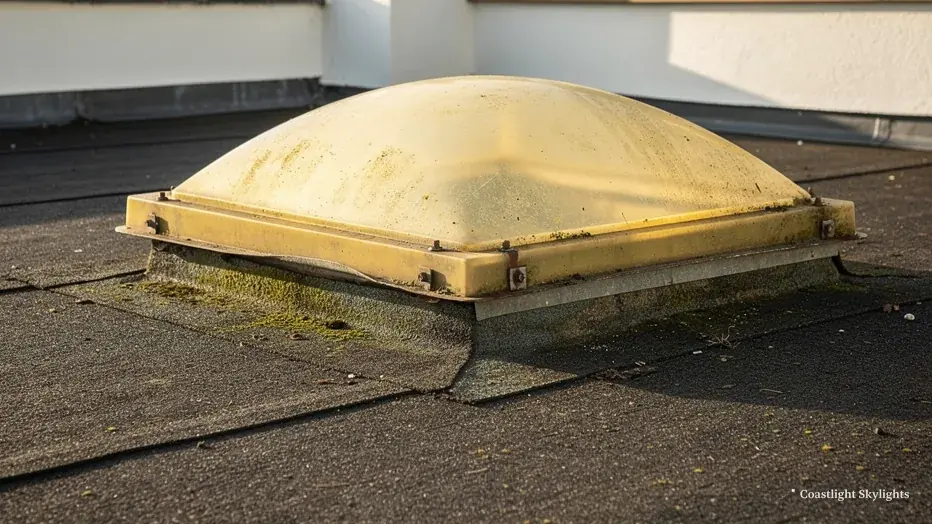
- Yellowing and clouding. Ultraviolet light slowly changes the plastic. The clear bubble turns amber or milky, and less daylight reaches the room.
- Crazing. Fine cracks spread across the surface, especially at the corners and around fixings.
- Brittleness. The material loses flexibility. A dome that once bounced back from hail or a falling branch may now crack under little stress.
- Warping. The skin sags or lifts at the edge, and the seal against the frame no longer meets evenly.
- Condensation between skins. A double or triple skinned dome is not always airtight, and damp air gets into the gap. This is the plastic equivalent of a glass unit fogging, and our page on why rooflights mist between the panes explains the glass version.
- Leaking at the frame. The seal and the flashing at the base harden and part company with the kerb.
A plastic dome with cracks or a sagging skin is not safe to walk beside, let alone on. Please keep off the roof and do not lean on the dome from inside.
Why the dome is not simply cleaned or patched
Yellowing and crazing run through the plastic itself, so polishing or cleaning only reaches the surface. A cracked dome cannot be mended in a way that lasts, because the material around the crack is as brittle as the crack. A dome with condensation between the skins has a damaged gap that cannot be reopened and dried. The honest course is to take the dome out and fit a new rooflight, and our page on whether a misted rooflight can be cleared gives the full reasoning.
What you can put in its place
The opening is already there, so you have choices about what goes into it. Here are the main ones.
| Option | What it is | Good for |
|---|---|---|
| New dome | Modern plastic dome on a new frame | Plain utility spaces, a quick like-for-like swap |
| Flat glass rooflight | Sealed glass unit in a low-profile frame | Kitchens, bathrooms, rooms where the view matters |
| Opening rooflight | Hinged or electric glass unit | Rooms that need ventilation |
| Roof lantern | Raised glazed structure over a larger opening | Extensions and open plan rooms |
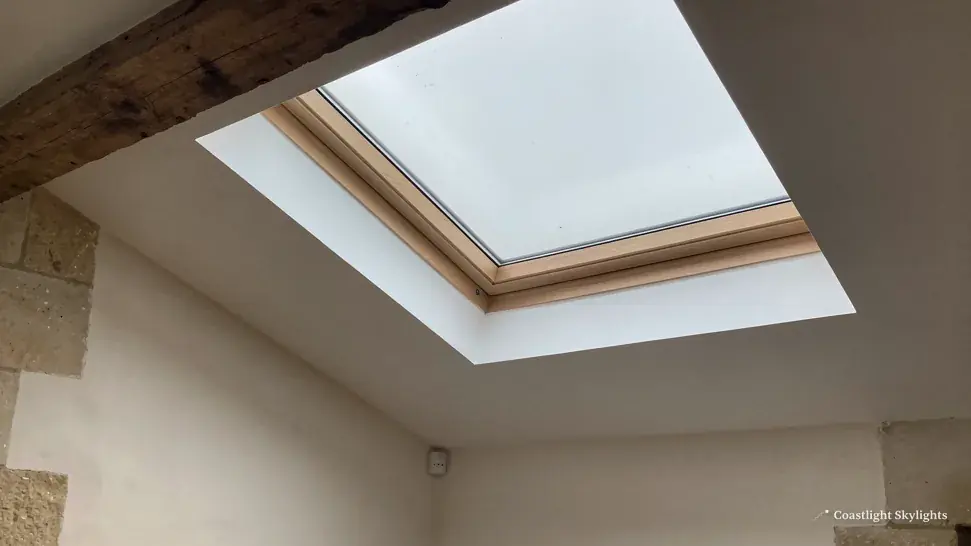
A modern plastic dome is a legitimate choice where the budget or the use calls for it. A flat glass unit looks cleaner from inside and outside, resists scratching and yellowing, and usually insulates better. You can read more about flat roof rooflights and roof lanterns on their own pages, and about electric and opening rooflights if a room gets stuffy.
The kerb underneath
The dome is only half of the job. The kerb that carries it is often the same age and may be in worse shape. A timber kerb that has been wet for years can soften, and a moulded kerb can crack at the corners. If the kerb is weak, a new rooflight sitting on it will fail early, because it is held by a base that moves.
At the survey we look at the kerb from the roof, test it for soundness, and check how the roof covering turns up against it. The covering might be felt, a single ply membrane, asphalt or a liquid coating, and each is dressed in a different way. Where the kerb is sound, we can fit the new unit onto it. Where it is not, we rebuild or replace it so that the new rooflight has a solid, level, well insulated seat.
What the Building Regulations ask for
Taking out a dome and fitting a new rooflight in its place is building work, even though the opening is not changing. It is notifiable. The new unit must meet Part L, which for a rooflight on a flat roof means 2.2 W/m²K. A plastic dome from several decades ago is almost certainly well short of that, so the replacement will be a clear step up in heat loss. A dome swap is notifiable, so we send the notice, to a registered building control approver or to the council, whichever the job uses. The standards are laid out in the Building Regulations explainer, and a short answer is on the page about whether replacing a rooflight needs Building Regulations approval.
If you want a better thermal result than the minimum, our page on energy efficient rooflights explains the options.
Planning and the opening
If the new rooflight is the same size and sits in the same opening, planning is rarely a question. If you want a larger opening or a raised lantern, rules apply. On a house, Class C of permitted development allows rooflights subject to conditions, including how far a unit may protrude and how high it can sit. Flats have no permitted development rights for rooflights, so a new or changed rooflight on a flat needs planning permission. Being inside a conservation area leaves a house's rights intact unless an Article 4 direction withdraws them, and the council has applied such directions across a good number of its conservation areas. Listed buildings need listed building consent as well. To check your address, use the Brighton and Hove planning guide.
Getting to a flat roof
Domes sit on flat roofs, and flat roofs in Brighton and Hove are often hard to reach. Many are on the back of a tall terrace, behind a parapet, over a rear extension with a narrow side return, or on top of a building with a shared stair. Every quote comes with a written access plan. It picks the way up, be that scaffold at the back through the garden, a tower on the street or a mobile platform, and it shows that the council's scaffold licence and any bay suspension are applied for by us rather than by you. The plan also covers the Building Control route and the price. The highway side is explained on the licensing page.
A dome is light enough that people sometimes ask whether scaffolding is needed at all. The answer depends on the roof, and our page on whether a rooflight can be replaced without scaffolding goes through it.
Flats and shared roofs
Where the dome is on the roof of a converted house or a block, the roof usually belongs to the freeholder. Before the dome comes out, a leaseholder will usually need written permission from the freeholder, called a licence for alterations. Check your lease, and see flat and leasehold rooflights. We do not give legal advice, but we can tell you what we need to know to plan the job.
How the swap is done
The work follows a clear order, which you can see in more detail on our page about what replacing a failed rooflight involves.
- Survey. We check the dome, the kerb and the roof covering from inside and from the roof, and measure the opening.
- Quote and plan. The price is fixed in writing, and the access plan sits on a page of its own beside it.
- Strip out. We set up access, protect the room below, and lift the old dome and frame away.
- Kerb and covering. We make the kerb sound, then dress the roof covering up and around it.
- Fit. The new rooflight is set, fixed and sealed, and the junction is weathered.
- Finish. We clear the roof and the room, and look after the Building Control notification.
Safety around brittle plastic
An old dome is more fragile than it looks. Sun-baked acrylic can shatter into sharp pieces, and a dome that gives way under a person leads to a fall through the opening into the room below. That is why we never rely on an old dome to take weight, and why we lay boards or a crawling surface across the roof before anyone works near it. If you have a ladder against the wall and are tempted to check the dome yourself, leave it to us. Everything we need to judge the dome can be seen from inside or by a surveyor with proper access.
If a dome has already cracked and rain is entering, tell us when you book the survey so that we can plan around it, and cover the area below with a sheet in the meantime. Do not stand under the opening if a piece looks loose.
Daylight, privacy and glare
A yellowed dome cuts the quality of daylight in a room, but a new clear unit changes the room too, and it is worth thinking about before you choose. Clear glass brings in more light and a view of the sky. A frosted or tinted pane gives privacy where a neighbour overlooks the roof, and a solar control coating cuts glare and heat in a south-facing kitchen. Blinds can be added to a glass unit, and an opening unit adds ventilation. These choices are made once, so settle them at the survey, while we can show you the options against the actual opening.
If the dome lights a small room such as a bathroom or an inner landing, a modest flat rooflight is often all that is needed. If it lights a main living space, a larger unit or a lantern may be worth discussing, though a bigger opening changes the structure and the paperwork, as described above.
The inside of the opening
When the dome comes out, the lining of the shaft or the reveal below it is exposed. It might be plasterboard, plaster, timber boards or a tiled surface, and it often carries stains from years of condensation. It is worth deciding at the survey whether you want it redecorated, because the best moment to tackle it is when the rooflight is already out and the room is protected.
Short answers
Is a yellow dome dangerous?
Yellowing alone is a cosmetic and light-loss problem. The danger comes when the plastic is cracked or brittle, so keep off the roof and do not push against the dome.
Can I just replace the dome and keep the old frame?
It depends on the kerb and frame underneath. If both are sound, it can be done. If they are worn, the new dome will not last on them.
Will glass make the room warmer?
A modern sealed glass unit can insulate far better than an old plastic dome, and the new unit will have to meet the current standard.

Every replacement carries our 10-year workmanship guarantee. To get your own dome inspected, ask for a free survey on the quote form, or go back to the main guide to misted and failed rooflights.