When a skylight has failed, the first decision is how much of it to take out. You can replace rooflight glass or unit as a whole: a new sealed glass unit set into the frame you already have, or a complete new rooflight with its own frame. Both are real options, and neither is right for every roof. This page sets out how we decide between them, what each involves, and how the Building Regulations treat the two. It supports our main guide to misted and failed rooflights in Brighton and Hove.
The two routes in plain terms
A rooflight is made of several parts. There is the glass, which is nearly always a sealed unit of two or three panes. There is the frame that holds the glass, whether that is aluminium, timber or PVC. And there is the way the frame joins the roof: an upstand or kerb on a flat roof, or a flashing kit on a pitched slope.
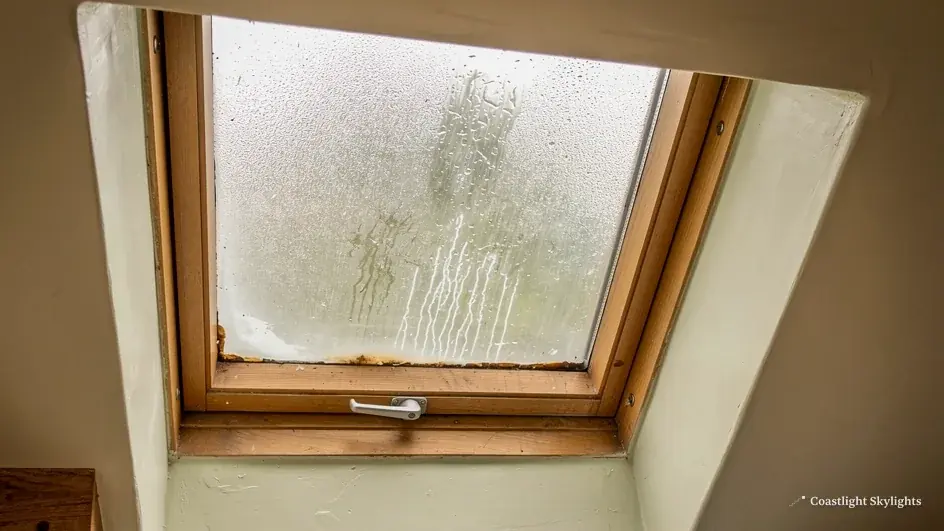
The glass is the part that wears out first. A sealed unit has an edge seal, and when that seal lets go you get fogging between the panes. We explain the cause in our page on why rooflights mist between the panes. The frame and the kerb may be perfectly sound, or they may be as tired as the glass.
That is the choice. If everything but the glass is in good order, a new glass unit can go into the existing frame. If the frame, the kerb or the junction with the roof has also reached the end of its life, the sensible move is a whole new rooflight.
When a new glass unit is the right answer
Changing only the glass works when the structure around it is sound. We look for these things at the survey.
- A frame that is straight, square and free of rot, corrosion or warping.
- Beads, gaskets and glazing bars that can be taken off and put back without breaking.
- A kerb or upstand that is dry, solid and still at the right height.
- Flashings and the roof covering around the unit in good condition, with no sign of water getting past them.
- A frame that can carry a new unit of the same thickness, or one that is slightly different.
The glass is made to size in a factory, so we measure the opening accurately before it is ordered. That takes a little planning, and the new unit arrives ready to fit. On a good frame, this route keeps the look of the rooflight exactly as it was and usually involves less disruption inside the room.
The limits of a glass-only change
A new sealed unit cannot improve the frame it sits in. If the frame is old and loses heat, that stays. The new glass is only as good as the support around it, and a worn frame can let the new seal fail early. For that reason we do not offer a glass-only change when the frame itself is the weak point.
When the whole rooflight should come out
A full replacement makes sense when the problem is bigger than the glass. These are the usual signs.
- A timber frame with soft or crumbling patches, or an aluminium frame with corrosion at the corners.
- A frame that has racked, so the glass no longer sits evenly and the new unit would be stressed.
- A kerb that has cracked, moved or lost its insulation.
- Flashing or lead that has failed at the junction with the roof.
- A rooflight that has been in place so long that the opening mechanism, hinges or seals have worn out.
- A unit whose glass is thinner or lower performing than anything now made, so a change of glass alone could not bring the whole opening up to standard.
A whole new rooflight comes with a new frame, new seals and a new connection to the roof. It lets us bring the opening up to current standards in a single piece of work. It also gives you the chance to change the type: a flat roof rooflight to a roof lantern, or an older fixed unit to an electric opening rooflight, for example.
Side by side
| Question | New glass unit | Whole rooflight |
|---|---|---|
| Frame | Kept as it is | New |
| Kerb or flashing | Kept, if sound | Reworked or renewed |
| Appearance | Unchanged | Can change |
| Insulation gain | Glass only | Glass and frame |
| Building Regulations | Not a controlled fitting | Notifiable building work |
| Best when | Frame and roof are sound | Frame or roof has also worn out |
How the Building Regulations see the two options
This is where the two routes differ most, and it affects what you have to do before work begins.
When the whole rooflight or roof window comes out and a matching one goes in, that is building work and it is notifiable. The replacement must meet the Part L energy standard. In an existing dwelling a roof window needs 1.4 W/m²K or Window Energy Rating band B, and a flat-roof rooflight or lantern needs 2.2 W/m²K. The Building Control notification for these swaps comes from us, and it goes through the council or through a registered building control approver.
A glass-only change in a sound frame is not a controlled fitting, and Approved Document L says as much in paragraph 10.6. That is a useful distinction, but it does not make the glass route cheaper or better every time. It only means a different paperwork route applies. The wider rules are in our Building Regulations guide, and the question is answered directly under whether replacing a rooflight needs Building Regulations approval.
Planning and the look of the roof
A like-for-like replacement of an existing rooflight does not usually raise new planning questions, because the opening is already there. If you want to change the size, the position or the type, the answer can change. Rooflights on houses fall under Class C of permitted development, which has conditions on how far a unit protrudes and how high it sits, and flats have no permitted development rights at all. A conservation area address alone does not take those rights away, though an Article 4 direction can, and many of the city's conservation areas are covered by one. Listed buildings need listed building consent too. Check with the council, and read our rooflight planning guide for Brighton and Hove before you change anything beyond a straight swap.
What the survey covers
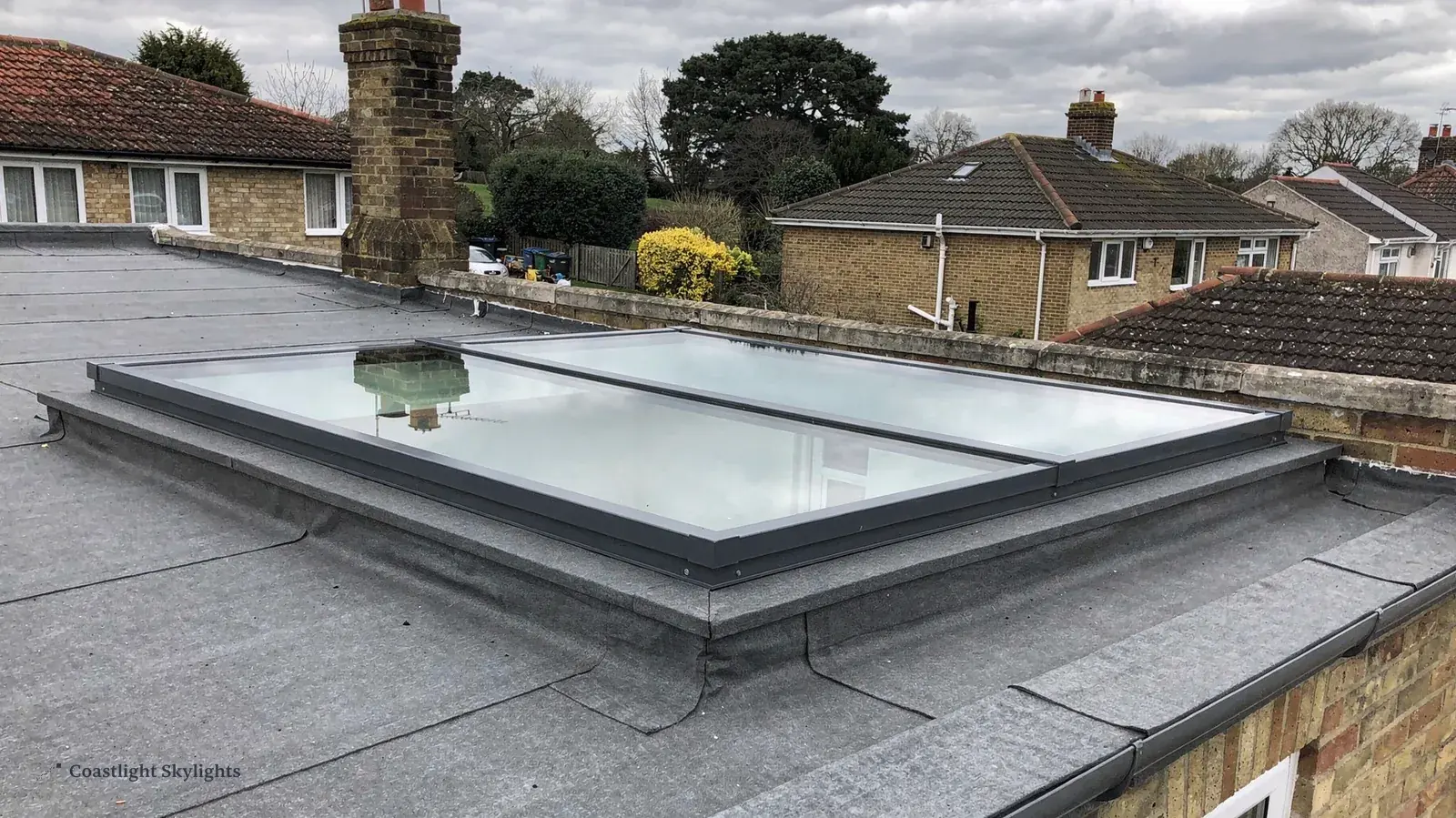
The free survey comes first. We study the rooflight from inside, then from the roof or a safe vantage point, and record the frame, the kerb, the flashings and the roof around them. We measure the opening carefully, as the glass or the new unit is made to those figures. We also check what is above and around the roof: a parapet, a valley gutter, a neighbour's wall, a mansard slope. You then receive a fixed written quote that names the route we recommend and explains why.
If you want to see how the numbers are built before you ask for a quote, our costs page sets out what moves the price, and the page on what it costs to replace a misted rooflight goes into more detail. The survey gives a firm figure for your own roof.
Reaching the work: scaffold, tower or platform
Access often shapes the choice. A glass unit is heavy and has to be lifted into place by hand or with a lifting aid, and a whole rooflight is larger still. On a tall terrace, over a parapet or on a roof with no safe route, the way we reach the work matters as much as the glazing. Every quote includes a written access plan. It lays out how we get up there, be it scaffold passed through the garden, a street tower or a mobile platform. The council's scaffold licence and any parking bay suspension are applied for by us, and the plan says so. It also covers the Building Control route and the price.
The highway side is covered in our note on licences and bay suspensions for roof work. A cheaper route is sometimes possible, and our page on replacing a rooflight without scaffolding shows when.
If you live in a flat
Where a building has been converted into flats, the freeholder normally owns the roof, and a leaseholder needs written consent from them, known as a licence for alterations, before any work to the rooflight. A whole new rooflight is more likely to need that consent than a new glass unit, but check your lease either way. We do not give legal advice. Freeholder consent and shared roofs are dealt with under rooflights in flats and leasehold buildings, and our access plan sets out the notice we give to neighbours.
Choosing the type again
If a whole new unit is on the cards, this is a good moment to think about what the room needs. A kitchen extension may suit a lantern, a loft room may want a roof window, and a landing that has no natural light might be better served by a sun tunnel. A conservation area may call for a conservation rooflight with a slim profile. A new unit can also reach a higher energy standard than the one it replaces, as explained on our page for energy efficient rooflights.
What the work looks like
Whichever route you choose, the order of work is similar. We set up access, take out the old glass or the old unit, check what is underneath, and fit the new part. Then we weather it, make good the junction with the roof, and clear the site. You will find the steps in full on our page about what replacing a failed rooflight involves. All of the work carries our 10-year workmanship guarantee.
Timing and weather
Rooflight work is weather work. A glass unit can usually be swapped in a short visit, but we still choose a dry spell, because the opening is exposed while the old unit is out. A whole rooflight takes longer, as the kerb or flashing is worked on and the new unit has to be made weathertight before we leave. In both cases the roof is closed up at the end of each working day. If you are not sure whether a fault is urgent, our page on whether a misted rooflight is urgent helps you judge.
The first step is always the same: a person looks at your roof. Photographs and measurements from a phone can start the conversation, but the choice between the two routes is made on the roof itself, with the frame in front of us.
A few quick answers
Can I swap just the glass to save effort?
If the frame, kerb and flashings are sound, yes, and it is a perfectly good route. If any of them is worn, the new glass will not last, so the survey decides.
Will a new unit look the same?
A glass-only change looks the same from inside and out. A whole new rooflight can match the old one or change it, and we show you the options at the survey.
Which one is better for heat loss?
A whole new rooflight can improve the glass and the frame together. A new glass unit improves the glass only. Neither route rescues a worn frame.
To find out which route suits your roof, ask for a free survey using the quote form, or return to the main guide to misted and failed rooflights.