The Coastlight guide
When a rooflight fails, and what replaces it
A rooflight that has gone cloudy, streaky or beaded with moisture between the panes is telling you something specific about its construction. This page explains what has happened to misted rooflights in Brighton & Hove, why the answer is replacement, and how we go about it, from the first survey to the last bead of sealant. If you want the wider picture first, start at the skylights and rooflights hub.
Sheet 01
The failed unit
Scale: the glass
Most modern skylights and rooflights are double glazed. Two sheets of glass are held apart by a spacer bar around the edge, and a seal bonds the whole sandwich together. The cavity between the sheets is meant to stay dry and closed for good. That closed cavity is what gives the glazing its insulation value, and it is what keeps the view clear.
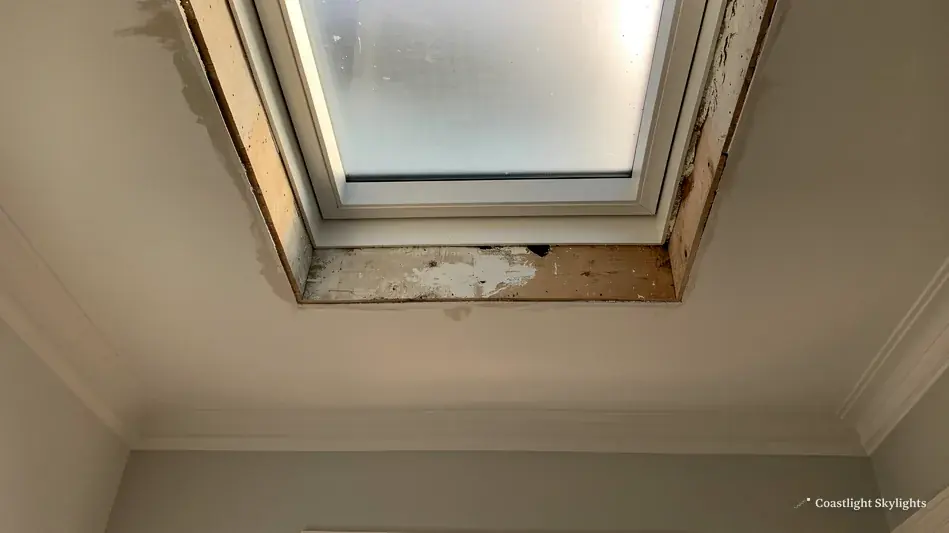
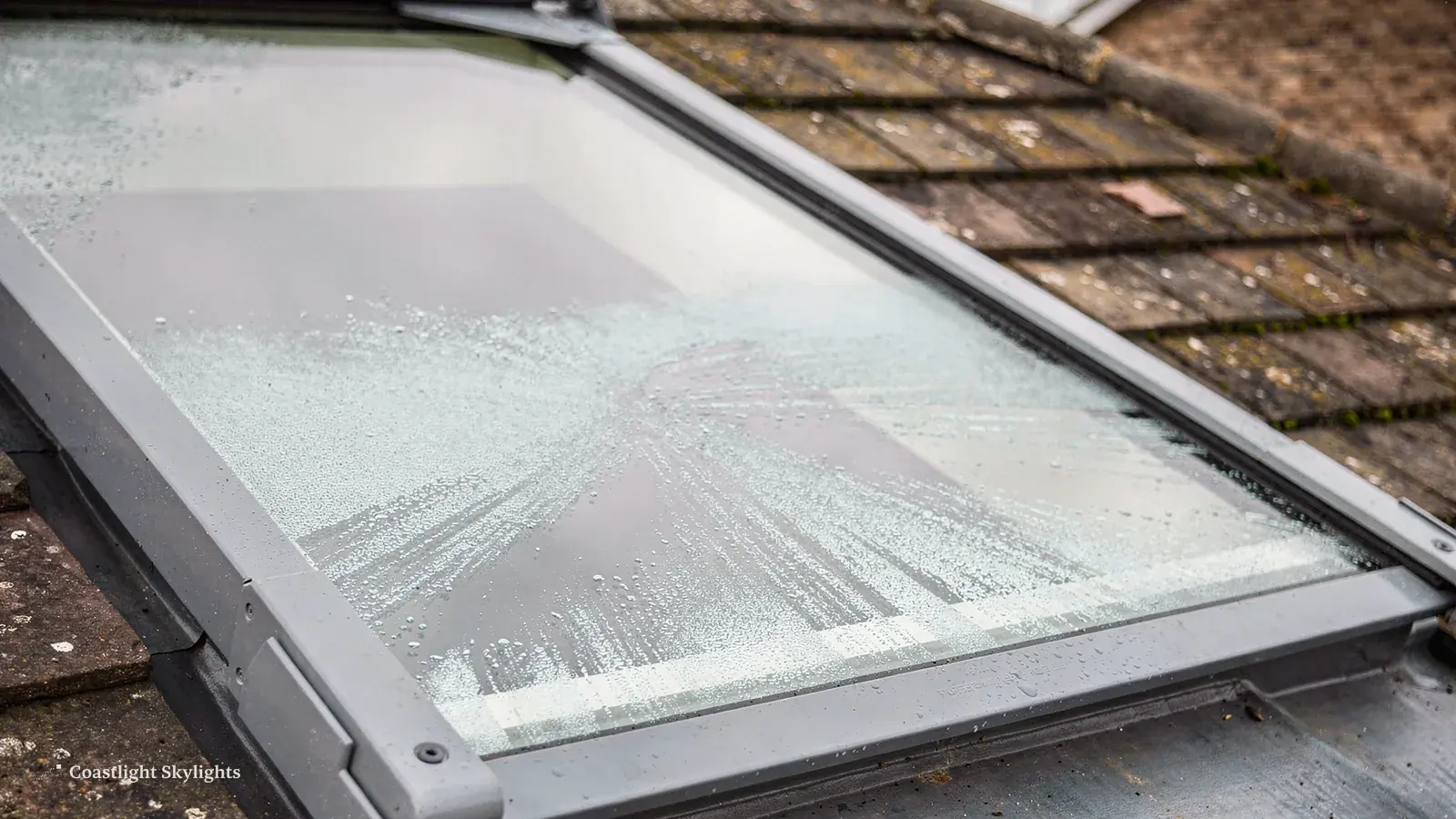
A failed unit is one where that seal has given up. You see it as a milky haze, a ring of droplets near the edge, or a lime-scale looking film that appears on warm mornings and never quite clears. It happens in order.
- The seal gives up. The bond around the edge no longer holds.
- Moist air gets in. It enters the cavity between the sheets.
- The drying agent fills. The agent in the spacer reaches capacity.
- Vapour condenses. Water vapour forms on the cold inner face of the outer pane.
Our page on why rooflights mist up between the panes goes through the causes in detail.
Misting between the panes is not condensation
Room-side condensation
A ventilation and humidity question.
- Wipes off
- Usually follows a shower or a pan of pasta
Misting between the panes
Inside the sealed cavity.
- Cannot be wiped off
- If a cloth across the haze leaves it put, the glass has failed
Sometimes the two things happen together. A badly ventilated bathroom with a rooflight above the bath will throw condensation on the inner face, and a failed unit above it will look worse because the two layers of moisture combine. Clean and dry the inside face first. If the cloudiness is still there, it is in the cavity.
Where failed units show up on a Brighton & Hove roof
Sea air is hard on edge seals, and so is the swing between a cold clear night and a bright south-facing morning. Rooflights on the seaward slopes of a terrace take the salt and the wind. Units in a flat roof that holds standing water around the kerb sit wet for long stretches, and a seal that sits in water is a seal on borrowed time. A roof window above a loft bedroom takes sun all afternoon and cools fast at dusk, which is exactly the thermal cycling that works on a spacer bond.
None of that means your rooflight was badly made. It means the unit did what sealed units do at the end of their working life.
Sheet 02
The replacement
Scale: your rooflight
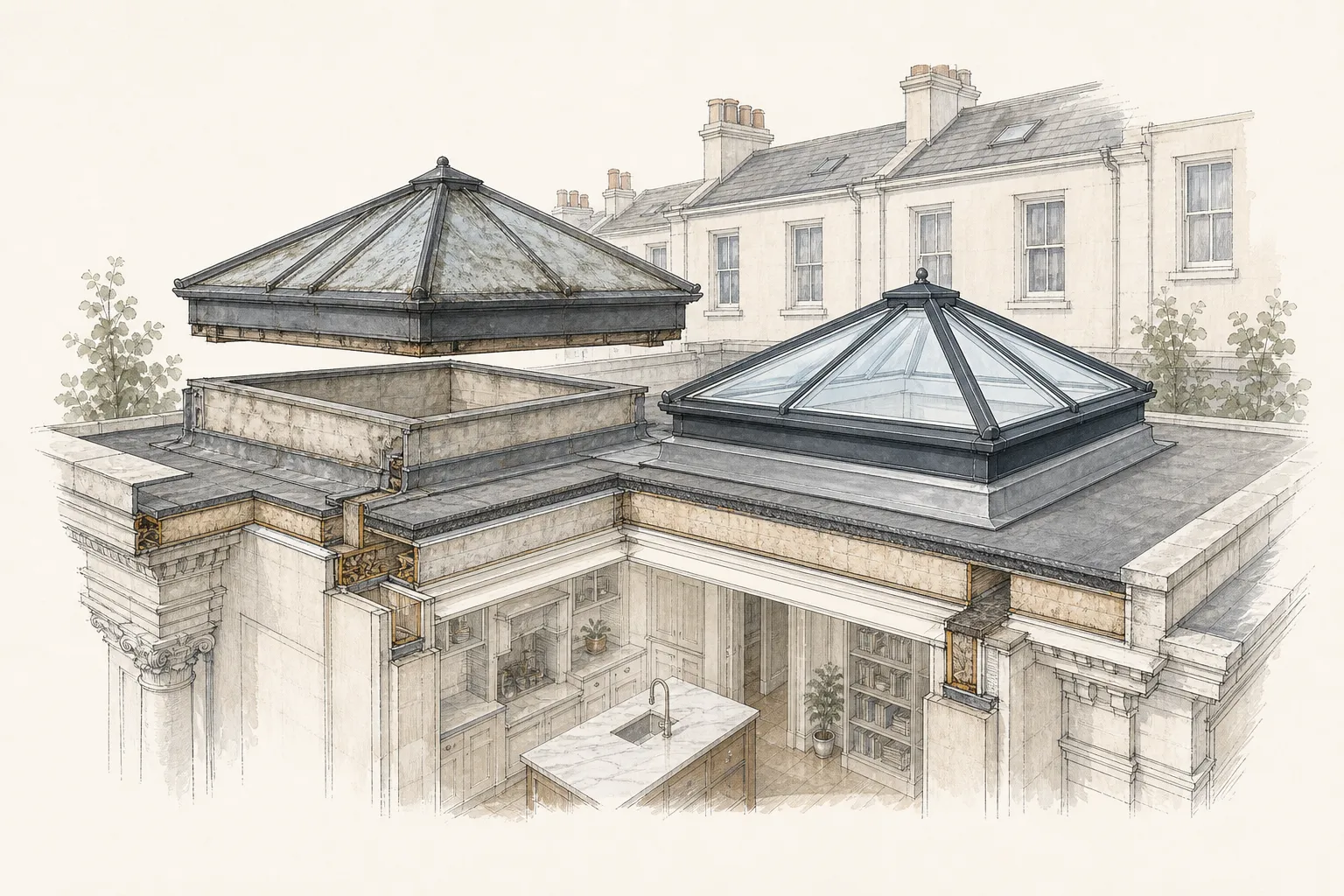
Once the seal has failed, there is no way to dry out and re-seal the cavity in a way that lasts. A replacement is a new sealed unit, or, where the frame is also past it, a whole new rooflight or roof window. Which of the two you need is a judgement made on the roof, and our page on replacing the glass or the whole rooflight sets out how that call is made.
| What we find | Usual outcome |
|---|---|
| Sound frame, failed glass only | New sealed glazing unit |
| Frame rot, corrosion or movement | Whole new rooflight |
| Old single-skin plastic dome | Whole new rooflight |
| Kerb damaged or out of square | Whole new rooflight, kerb corrected |
| Roof window with failed seal | New unit, same size where possible |
A new glazing unit in a sound frame
Where the frame, the opening gear and the flashing are all in good order and the only fault is the glazing, the unit can be taken out and a new one made to size can go in. The old frame stays. It is the quicker and cheaper route, and it only makes sense when the frame is genuinely sound: no rot in a timber frame, no corrosion pitting in an aluminium one, no sagging or twist.
A whole new rooflight or roof window
If the frame has moved, the kerb is out of square, or the unit is an old single-skin plastic dome, we recommend replacing the entire rooflight. A new unit comes with modern glazing, a thermally broken frame and an upstand that fits the roof as it is now, not as it was when the original was fitted. If your failed unit is an old dome, see replacing an old plastic dome rooflight.
On a pitched roof, the equivalent is a new roof window, often a VELUX window where one is already fitted. We keep the same size where the rafters allow it, which keeps the work to a swap rather than a structural change. Our roof windows and VELUX windows pages cover the new-unit side in more depth.
Sheet 03
The kerb it sits on
Scale: the kerb
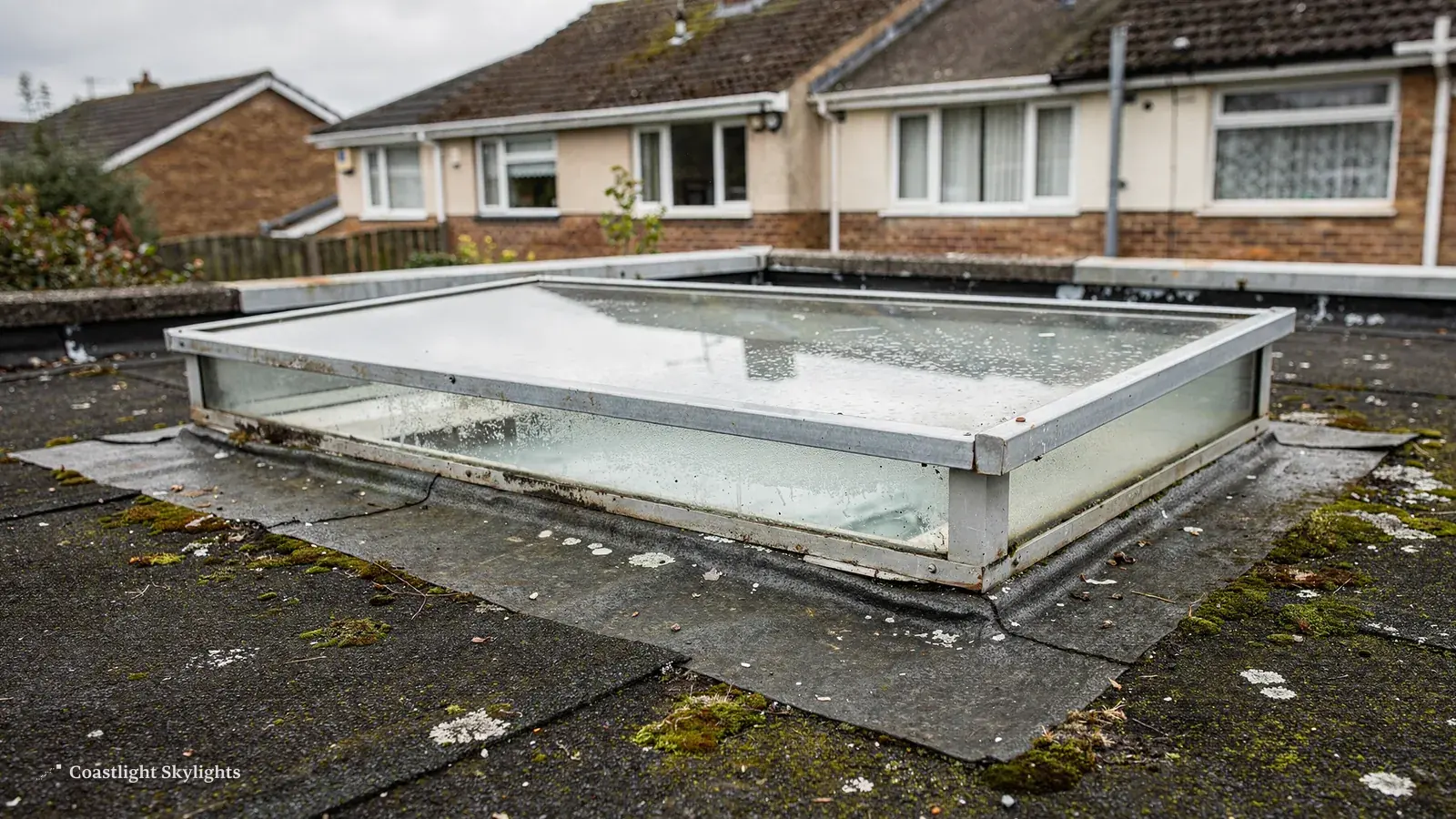
A rooflight is only as good as the thing it sits on. On a flat roof that is the kerb: a raised timber or insulated upstand, covered with the roof membrane, that lifts the glazing above the water line and carries the weight. Kerbs, upstands and the weatherproofing of the roof around them decide whether a new rooflight stays dry or starts a different problem.
What we check before the old unit comes off
Flat roofs are usually finished in felt, GRP fibreglass or EPDM rubber membrane. Whichever you have, three things get checked.
| Check | What we look for |
|---|---|
| The membrane | How it is dressed up the face of the kerb, and whether it is lifting or cracked at the corners |
| The kerb | Whether it has softened; a timber kerb wet for years is soft at the base |
| The fall | Whether water is pooling around the kerb, because standing water against an upstand tests every joint |
Weatherproofing a replacement
When the new rooflight is lifted into place, the flashing and the membrane are re-dressed so water has a clear route off and over the roof, not behind the frame. Where the existing membrane is sound, it is cut back neatly and tied into the new upstand. Where it is not, the affected area is re-laid so the kerb is not sitting on tired material. Our flat roof rooflights page shows what a finished kerb looks like.
Pitched roofs and flashing
On a pitched roof the equivalent job is the flashing kit around a roof window. Slate and tile need different flashing, and an old frame removed from a roof covered in slate often reveals lead soakers that are worth keeping and ones that are not. The new unit is flashed to match the roof covering in front of us, not the covering that was there when the original was fitted.
Sheet 04
Types of misted rooflight and which suits your roof
Scale: your roof
Misting turns up on every kind of glazed roof opening, and the replacement depends on what you have now. Here is how the common types break down across the roofs we see in the city and the towns around it.
Opening, walk-on, conservation and sun tunnel units
| Type | What it is | Replacement |
|---|---|---|
| Opening or electric | Adds a motor, a rain sensor or a control link | Opening gear checked at the same time; see electric and opening rooflights |
| Walk-on rooflight | Carries load, with structural glass | Replaced to the same loading, never a substitute |
| Conservation rooflight | Sits flush with the roof, often in a listed building or a conservation area | The replacement keeps the slim profile |
| Sun tunnel | A dome and a diffuser | When the dome mists the whole fitting is usually swapped |
Flat roof rooflights and lanterns
These take the hardest weather. A rooflight on a kitchen extension, a rear addition on a Victorian terrace or a flat-roofed garden room is exposed on all sides, and the glass often reaches the end of its life together with the membrane around it. A flat roof rooflight is replaced like for like, or upgraded to a better specified unit.
A roof lantern is built up from several panes of glazing, a ridge and a perimeter frame, and when it mists it is usually one or two panes that go first. A lantern can sometimes be re-glazed pane by pane when the frame is sound. A frame that has weathered badly is replaced as a whole.
Roof windows and VELUX
In a pitched roof, the usual failure is the sealed unit in a roof window, including VELUX windows fitted when a loft was converted. A VELUX window can be replaced with a like for like unit when the size and type still suit your needs. Size codes confuse people: in a code such as MK04, the letter is the width and the digits are the height, so a quick read of the code on the old frame tells us what the replacement needs to match.
Sheet 05
How the installation works
Scale: the sequence
A replacement installation is not complicated, but it has a sequence, and the order matters most when the roof is open. We keep the sequence the same on every job so that nothing is decided on the roof for the first time. The full account is on the page what replacing a failed rooflight involves. This is the short version.
- Survey. We visit by appointment, look at the unit from inside and out, and check the kerb, the membrane or the flashing, and the frame.
- Fixed written quote. You receive a quote with a fixed figure and the access plan attached, so the route to the roof, the scaffold and the Building Control step are all on one page.
- Access in place. Scaffold, tower or platform goes up, with any council licence or bay suspension applied for by us beforehand.
- Strip and prepare. The old unit comes off, the kerb is checked and corrected, and the roof is made watertight for the interval.
- Fit and weather. The new rooflight or roof window is set, fixed and flashed, with insulation packed round the frame.
- Finish and notify. We tidy the room below, test any opening gear, and send the Building Control notification when the replacement is notifiable.
What happens inside the house
Where a lantern or large rooflight is coming out, we make sure nothing is stored under the opening. Blinds and any motorised fittings are disconnected carefully and tested afterwards.
Weather and timing
No one fits a rooflight into a downpour. If the forecast turns, the roof is made watertight and the job resumes when it clears. We would rather lose a morning than leave you with a wet ceiling.
Sheet 06
Planning permission and Building Regulations
Scale: the statute book
Replacing a misted unit is the sort of job people assume needs no paperwork. Sometimes it does not, and sometimes it does. The difference is whether you are changing only the glass, or replacing the whole unit.
| Job | Building Regulations | Planning |
|---|---|---|
| Glass only, frame sound | Not a controlled fitting | Rarely a question for a house |
| Whole unit, like for like | Notifiable, must meet Part L | Conditions apply under permitted development |
| Flat, listed or Article 4 area | The same as for a house: glass only is not controlled, a whole unit is notifiable | Talk to the council first |
Part L and notification for the new unit
Replacing a whole rooflight or roof window, like for like, counts as building work. It is notifiable, and the new unit has to meet Part L of the Building Regulations. For an existing dwelling, a pitched-roof window has to reach 1.4 W/m²K or Window Energy Rating band B. The figure for a flat-roof rooflight or lantern is 2.2 W/m²K. Replacing only the glass in a frame that is sound is not treated as a controlled fitting under the guidance in Approved Document L, so the regulations do not bite in the same way.
We submit the notification ourselves for a notifiable replacement, whether the route is a registered building control approver or the council's own team. Our pages on Building Regulations for skylights and rooflights and whether replacing a rooflight needs Building Regulations approval set out the detail.
Planning permission
A like for like replacement in the same opening, at the same size, rarely raises a planning question for a house. Permitted development for house rooflights comes with conditions: the new unit may project no further than 150 mm from the roof plane, and its top has to stay below the roof's highest point. Flats do not have those rights, so anything beyond a straight swap in a flat needs a conversation with the council first.
Sitting in a conservation area is not enough on its own to take those rights away. Only a planning condition or an Article 4 direction does that, and the council has applied Article 4 to a number of conservation areas in the city, so confirm your address with it first. A listed building needs listed building consent in addition for anything that affects its character. Houses within the South Downs National Park come under the Park Authority for planning purposes. Our planning guide goes through each case.
Paperwork to ask for
Whoever you choose to do the installation, ask to see how the Building Control notification will be handled, and ask for the route in writing. We put it in the access plan, so it sits next to the price rather than behind it.
Sheet 07
Glass only or the whole unit: how to decide
Scale: the decision
People search for a repair when a rooflight mists, which is understandable. The honest answer is that a failed sealed unit cannot be repaired. There is no way to re-open the cavity, dry it, refill it and bond the seal in a way that holds up on a roof. So the real question is not repair versus replace. It is which replacement is proportionate. The page on whether a misted rooflight can be cleared covers why the cheaper-sounding fixes do not last.
Signs that point to the glass only, or the whole unit
Glass only
- The frame is straight, solid and well decorated or coated.
- The opening gear works smoothly and the seals around the sash are intact.
- The kerb and membrane are in good order with no staining on the ceiling below.
- The only visible fault is mist or haze between the panes.
The whole unit
- Rot, corrosion or movement in the frame.
- Stained ceiling plaster or a tide mark under the opening.
- A single-skin plastic dome with a cracked or yellowed cover.
- A unit that was never thermally broken and shows cold bridging on the inner face.
Cost and what moves it
The price depends on the size of the unit, the type of glass, the kerb or flashing condition, and above all the access to the roof. A rooflight on a ground floor extension that can be reached from a mobile platform costs less to reach than one on a fourth floor terrace behind a parapet. We do not quote figures here because a fixed written quote after a free survey is the only number worth trusting. Our replacement cost guide and the costs page explain the factors.
Sheet 08
Reaching the roof
Scale: the street
In Brighton & Hove, the glass is rarely the hard part. Getting to the roof is. The city is full of tall terraces, butterfly roofs behind parapets, mansards, converted flats and streets where nobody parks without a permit. A rooflight sits in the middle of all that, and a new unit is a pane of glass that has to be lifted to it.
Can a rooflight be replaced without scaffolding?
Sometimes, without full scaffold
A low roof reached by ladder or a mobile platform can be done, as long as the glass can be lifted in safely.
- Stated in the plan
Not on a high or awkward roof
Where the answer is no, we say why.
- See can a rooflight be replaced without scaffolding for the cases
The access plan
That is why every quote carries a written access plan. For a misted unit it spells out the way up, be that garden scaffold, a tower from the street or a mobile platform. It says who applies for the council's scaffold licence and any parking bay suspension (we do). It says whether a freeholder's consent or a licence for alterations is needed, what notice neighbours receive, the Building Control route, and the price. Pavement scaffold and bay suspensions are covered in our scaffold licence guide.
Butterfly roofs, parapets and mansards
A butterfly roof falls to a central valley, with a parapet at the front and back. A rooflight in or near that valley is exposed to every leaf and every gull. Access over a parapet means lifting glass over a wall, and the scaffold has to be built to carry it. On a mansard, the steep lower slope and the shallow upper slope each have their own detail, and a roof window in the steep part sits at a very different angle to one in the flat deck above.
Flats and shared roofs
In a converted house, the roof is usually the freeholder's. Before a misted rooflight in a flat is swapped, the leaseholder normally has to obtain a licence for alterations, meaning the freeholder's consent in writing. Check your lease. The usual position is set out in our leasehold rooflight guide. We list the consent step in the access plan when the building needs it.
Sheet 09
Why daylight matters
Scale: the room
A misted rooflight does not only look poor. A hazy unit lets less daylight into the room and flattens the view of the sky. The room below feels darker than it should, and the lights go on earlier. Replacing the unit restores the natural light the opening was put in to deliver.
Light, warmth and ventilation
| Area | What changes |
|---|---|
| Glazing | A modern replacement has better glazing than the unit it replaces; see energy efficient rooflights |
| Insulation | Better insulation round the opening, where the old frame is often where cold air and condensation gather |
| Ventilation | An opening or electric version lets warm air out at the top of the house and helps a bathroom that steams up |
Loft rooms
In a loft conversion, a roof window is often the only daylight a room has. The Building Regulations set no daylight standard for houses in England, but a bedroom with a clouded window feels it. Means of escape matters here too. A window can be the escape route only on a storey about 4.5 m or less above the ground. A loft on a two-storey house needs a protected stair, not an escape roof window. A roof window can serve as an escape in a bungalow or chalet bungalow within that height, and any replacement has to keep that function.
Blinds, security and noise
Some roof windows have integrated blinds, which can be motorised. If yours does, the replacement needs to match the blind system or be matched with a new one. Laminated glazing is worth asking about on ground level roofs and rooflights above a flat roof extension, for security and for rain noise. We cover the options on the survey.
Sheet 10
Why choose a local installer
Scale: the district
A local installer knows how the roofs behave. Brighton & Hove is one city, but the roofs change street by street, from the Regency terraces and their parapets to the semi-detached houses of the outer estates, and from the seafront blocks to the downland villages. A person who has been on those roofs will find the problem faster and will plan the access to suit.
What local means in practice
In practice it comes down to three things. There are no public premises, so every visit is booked and every visit is to your roof.
- A free survey. At a time that suits you.
- A fixed written quote. With an access plan written for your address.
- Licences handled by us. We apply for the scaffold licence and the bay suspension ourselves, with the right highway authority: Brighton & Hove City Council in the city, and East Sussex County Council or West Sussex County Council beyond it.
The work carries a 10 year workmanship guarantee, and you can read the terms on our guarantee page.
Where we work around Brighton & Hove
We cover the city and the area up to 30 miles around by road, which takes in the coast east and west, the towns inland and the villages on and below the Downs. Planning and Building Control differ slightly from one authority to the next, and we know the routes in each. For a visit, contact us, or send photographs through the quote form.
If the rooflight is not yet failing but you want to know what you have, the page on whether a misted rooflight is urgent helps you judge how long you can wait.
Misted rooflights: what homeowners ask us on the doorstep
Can a misted rooflight be cleared or fixed?
Not from outside. The mist is between the panes, in a sealed cavity, so cleaning does not reach it. A failed unit is replaced. The page on whether a misted rooflight can be cleared explains why.
Is a misted rooflight urgent?
The glass is not dangerous, but the cause may be. A misted unit often sits beside a worn kerb or tired flashing, and water finds those faster than glass fails. Have it looked at before the next winter. See is a misted rooflight urgent.
How much does it cost to replace a misted rooflight?
It depends on the size, the glazing, the condition of the kerb and the access. The survey is free and the quote that follows is a fixed written figure. The cost guide lists what moves the price.
Do roofers fit skylights?
Many do, but a rooflight is a joint between glazing, structure and roof covering, and it needs all three right. We install and replace skylights and rooflights as our work, including the access, the weathering and the Building Control step.
Does a replacement VELUX window need to be a VELUX?
No. What matters is that the new roof window fits the opening, meets 1.4 W/m²K or band B, and is flashed for your roof covering. If your existing unit is a VELUX, a like for like replacement is often the simplest route. See our VELUX windows page.
Is planning permission needed to replace a rooflight?
For a house, a like for like swap rarely needs it, but conditions apply, and Article 4 directions and listed buildings change the answer. Flats have no permitted development rights. Check the planning guide, then ask the council.
Ready to get a quote?
Use the quote form or call 01273 282313. The next step is a free survey, after which you receive a fixed written quote and the access plan. Back to the skylights and rooflights hub if you want to look at other options first.