A rooflight rain sensor does one plain job: when it detects water, it tells an electric rooflight (an electric skylight, in everyday speech) to close. Smart controls build on that idea with timers, temperature settings and phone apps. This guide explains how each works, where the sensor goes, what it cannot do and what to ask before you choose. It belongs to our wider coverage of electric and opening rooflights in Brighton and Hove.
What a rain sensor does
The sensor is a small plate with a pair of conductive tracks on its surface. Dry, the tracks do not connect. When a raindrop lands across them, the water completes a circuit and the sensor sends a signal. The control unit reads that signal as an instruction to close the rooflight.
Many sensors include a small heating element. It dries the plate after the rain stops, so a single drop, dew or mist does not hold the rooflight shut for hours. Once the plate is dry the rooflight can be opened again, either by you or by the control.
The sensor is a simple device, and that is its strength. It does not forecast weather. It only reacts to water on the plate, which is why placing it correctly is so important.
Where the sensor goes
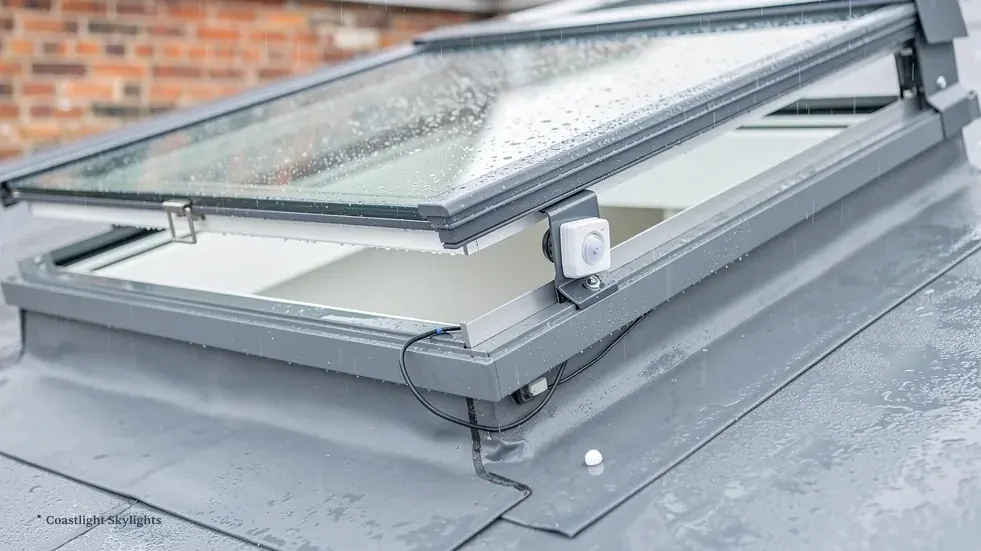
A rooflight rain sensor needs to meet rain before the room does. On a pitched roof it is usually fixed on the roof covering or the window frame, on the side the weather comes from. On a flat roof it sits on the upstand or kerb or on a post beside the unit. It must not be shaded by a parapet or a chimney, or it will stay dry while rain blows onto the open glazing from another direction.
In Brighton and Hove, wind-driven rain often arrives sideways. A sensor tucked under a deep parapet or behind a chimney stack may be sheltered when the rooflight is not. We position the sensor where the weather arrives, not where the cable is easy to run. If the best place is awkward to reach, that is a point to settle at the survey, not on the day.
Wired or wireless
A sensor must reach the controller. There are two ways to do that, and each suits different buildings.
Wired
A cable runs from the sensor to the control box.
- No batteries to replace
- A steady signal
- Needs a route for the cable
Wireless
The sensor talks to the controller by radio.
- No cable through the roof build-up
- Useful where the ceiling is already finished
- Needs power at the sensor, from a battery or a small solar cell
Neither is better in every case. If a rooflight is being installed new, with the ceiling open, a wired sensor is easy to arrange. If a unit is being added to a room that is already decorated, wireless often saves a great deal of mess.
What the sensor cannot do
A rain sensor is reactive. It closes the rooflight once water has already landed on it, so a little rain may get in before the glazing closes. For that reason it suits rooflights with a good seal and a deep upstand, and it suits rooms where a few drops do no harm. It is a protection for the days you forget, not a licence to leave a rooflight wide open over a sofa for a week.
Three other limits are worth knowing.
- It needs power. If the supply fails, the sensor cannot close the unit, unless there is a battery backup.
- It can be blocked. Leaves, bird droppings and dirt on the plate can stop it reading, so it needs an occasional wipe.
- It does not read wind. A gust can push the lid into trouble without any rain at all.
The power point links to a separate question we cover in what happens to an electric rooflight in a power cut.
Wind sensors and why they matter
On a high roof facing open ground, wind is as much a risk as rain. A wind sensor measures speed and tells the controller to close the unit when it passes a set limit. Whether you need one depends on the position of the rooflight and the size of the lid. A big glazed hatch on a roof terrace catches more wind than a small vent over a bathroom. We raise this at the survey where a unit is on an exposed roof, and the written quote lists whether a wind sensor is included.
What smart controls add
Smart controls link the rooflight to other inputs. The common ones are listed here, and you can choose some or all of them.
| Control | What it does | Best suited to |
|---|---|---|
| Wall switch or remote | Opens and closes on demand | Everyday use in one room |
| Timer | Opens and closes at set times | Rooms heated by afternoon sun |
| Temperature sensor | Opens when the room is warm and closes when it cools | Extensions and lofts that overheat |
| Humidity sensor | Opens to clear steam | Kitchens and bathrooms |
| App or voice link | Control from a phone or speaker | Several units, or users away from home |
These can be combined. A common set-up is a temperature sensor that opens the rooflight to vent heat, a rain sensor that overrules it when it rains, and a wall switch that overrides both when you want the rooflight shut.
Rules of priority
If a controller has several inputs, it needs a clear order of priority. Rain must override everything else, so a timer cannot open the unit during a shower. Wind comes next. Your own switch comes after those safety inputs unless you have chosen otherwise. A good installer sets this order at commissioning and writes it down for you. If the order is not clear, the rooflight can behave in surprising ways, for example opening on a hot afternoon with a storm approaching.
Smart rooflights and the home network
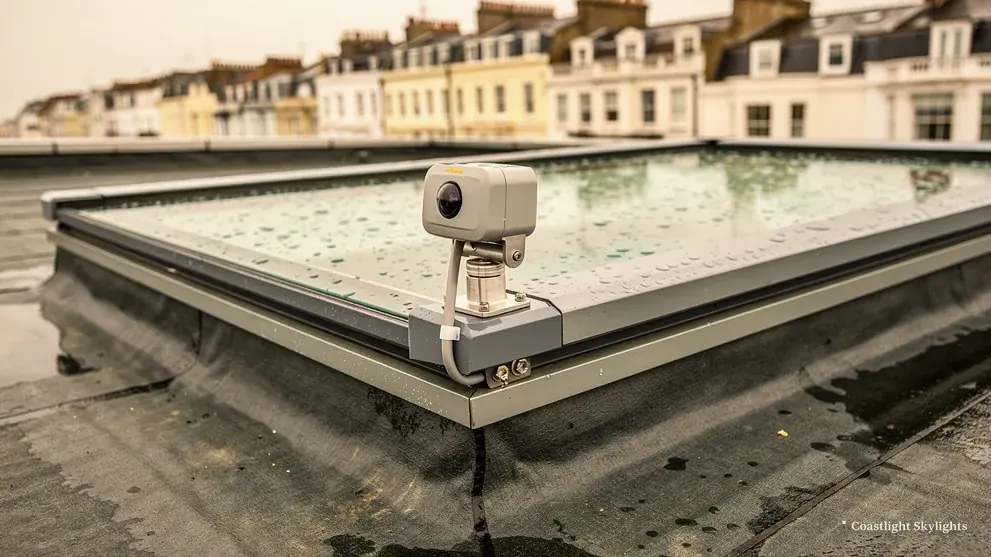
An app-controlled unit usually talks to a hub, and the hub joins your wireless network or a separate radio network. Think about what happens when the internet connection drops. A well-designed system keeps its local rules working without the internet: the rain sensor still closes the rooflight, and the wall switch still works. Only the phone and voice features depend on the connection. Ask the supplier which functions work offline before you choose.
It is also sensible to ask who looks after the software. A controller that stops receiving updates, or a hub that becomes unsupported, can leave you with a rooflight that works but cannot be controlled from your phone. A wall switch and a sensor are worth keeping as a fallback.
Testing the set-up after installation
A sensor should be tested before we leave, not trusted on faith. The test is simple: wet the plate with a little water and watch the rooflight close, then dry it and confirm the unit can be opened again. We repeat it for each sensor if there is more than one, and we check that a switch pressed during the test behaves as the priority order says it should.
You will be shown where the control box and the manual override are, how to clear the sensor plate, and what each button does. If the system has an app, we set it up with you present so that the first time you open the rooflight from your phone is not a guess. Keep the handover notes somewhere easy to find, since the settings are the part people forget.
Looking after the sensor
There is very little maintenance, but it is not none. Wipe the plate with a damp cloth now and then, and clear leaves from around it. Check after a storm that nothing has moved it out of position. If the sensor is solar powered, make sure nothing shades the cell. If it takes batteries, note the date they were fitted. A sensor that quietly stops working can leave a wet floor beneath an open unit, and a minute's care prevents it.
Wiring and the electrician
The motor and the control box need a power supply, and the sensor needs a connection. Electrical work in a home is done by a qualified electrician, who tests and certifies the circuit. We set out the cable routes and the positions of the box, the switch and the sensor at the survey, so that the electrician knows what is wanted. For the full answer, see does an electric rooflight need an electrician.
Fitting a sensor to an existing electric rooflight
If you already have an electric rooflight without a sensor, adding one is often possible. It depends on whether the controller has an input for a sensor, and whether the unit is the kind the sensor was made for. Some older controllers have no such input, and the control box would need replacing. The survey establishes what you have. If the unit is old or misting, replacement may make more sense than adding to it; see misted and failed rooflights. And if you are asking whether a manual rooflight can be motorised, read can an existing rooflight be motorised.
Choosing between manual and electric first
A sensor is only useful if the rooflight is electric. If you are still deciding on the opening method, our page on manual or electric opening rooflights compares the two. The ventilation side of the question is covered in opening rooflights for ventilation and summer heat.
Rain sensors and leaks
People sometimes assume a sensor is the thing that keeps an opening rooflight watertight. It is not. The seals, the upstand and the flashing do that, whether the unit is open or shut. The sensor only guards against rain falling into an open unit. For the weathering of opening units, see do opening rooflights leak.
Planning, regulations and cost
Adding a sensor to an existing unit usually changes nothing external. Fitting a new opening rooflight is another matter. On a house, a new rooflight may be permitted development, subject to conditions, and a flat needs planning permission. A listed building needs listed building consent, and permitted development rights can be taken away by an Article 4 direction or by a planning condition. Check first with the council, using the planning guide. New and replacement units are building work and must meet current energy values, which our Building Regulations guide explains. If the motorised unit counts as notifiable, we send the Building Control notice ourselves.
Costs depend on the controller, the number of sensors, the length of cable run and the access to the roof, so we do not quote figures here. The survey gives you a fixed written quote. Our costs page and the guide on how much an electric rooflight costs explain what moves the figure.
Reaching the roof to fit a sensor
The sensor goes where the weather lands, which is usually the roof. The route up, any scaffold licence and any parking bay suspension are set out in the access plan in your quote, and we apply for the licences. Where a building is split into flats, the roof may belong to the freeholder, so check rooflights in flats and leasehold buildings first.
What to ask before you buy
- Where will the rain sensor sit, and will it meet the weather before the room does?
- Is the sensor wired or wireless, and what powers it?
- Does the unit close during a power cut, or stay where it was?
- Does rain override the timer and the temperature setting?
- Which features still work if the internet is down?
- Where is the control box, and how is it reached later?
We answer each of these in the written quote, and our 10-year workmanship guarantee backs the installation. To plan a rooflight with a rain sensor that suits your roof, book a free survey, or return to electric and opening rooflights.