Cuckfield
Coaching-era tiles, flat extensions and replacing an old rooflight
Cuckfield lies 17 road miles northwards from central Brighton & Hove, on the southern slopes of the Weald. This is the local page behind our main Brighton & Hove rooflight page, written for the old market town and its roofs.
Sheet 01
When an older rooflight gives up
Scale: the glass
A house in an old town may well have had a rooflight or roof window fitted a few decades ago, and that unit may now be at the end of its life. The signs are rarely dramatic. A fogged patch between the panes that will not clear. A frame that no longer sits square. A faint brown stain on the lining at the lower corner of the opening.

Misting is a failed seal
A sealed double-glazed unit holds a gap between two panes. When the edge seal breaks, moist air gets in and condensation forms inside the gap where no cloth can reach. That is a failed unit. It cannot be repaired, and the honest answer is assessment and replacement. The misted rooflights page shows what we look for on the visit.
The reasons a seal fails are mundane. Sun on the glass day after day flexes the edge, water pools at the lower corner of a shallow pitch, and the sealant simply ages. It is rarely down to anything you did. What matters is what you do next. A misted unit still lets light in, but it is no longer insulating properly, and if the frame has also taken in water, the problem is quietly spreading into the timber around it.
Frames and flashings age too
The glass is not the only part that wears. Timber frames take in moisture, sealed edges perish, and the metal flashing round a roof window can lift or split where it meets the tiles. A frame that has moved can mean the unit is now loading a rafter it was never meant to. When we survey a failing rooflight, we look at the frame, the flashing and the structure below, not only the glass.
If the frame is still sound, we say so and tell you what that allows. Otherwise a new rooflight is a clear improvement on the one it replaces.
- Look We inspect the unit from inside and, where it is safe, from the roof.
- Measure We take the frame size, the pitch and the kerb or flashing details.
- Check the structure We examine the rafters or joists round the opening.
- Write it up The fixed written quote covers the unit, the access and the Building Control step.
- Fit The old unit is removed and the new one is installed and weathered.
Sheet 02
Houses with a past
Scale: the houses
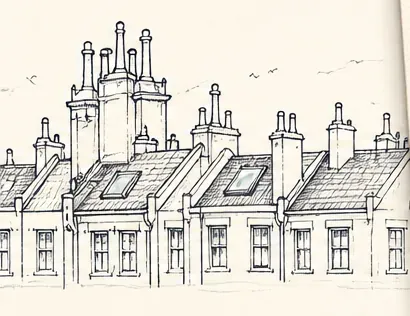
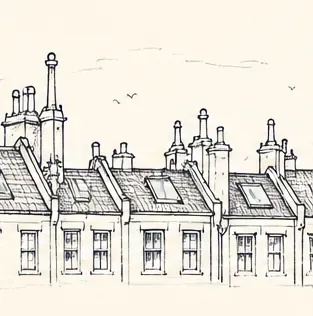
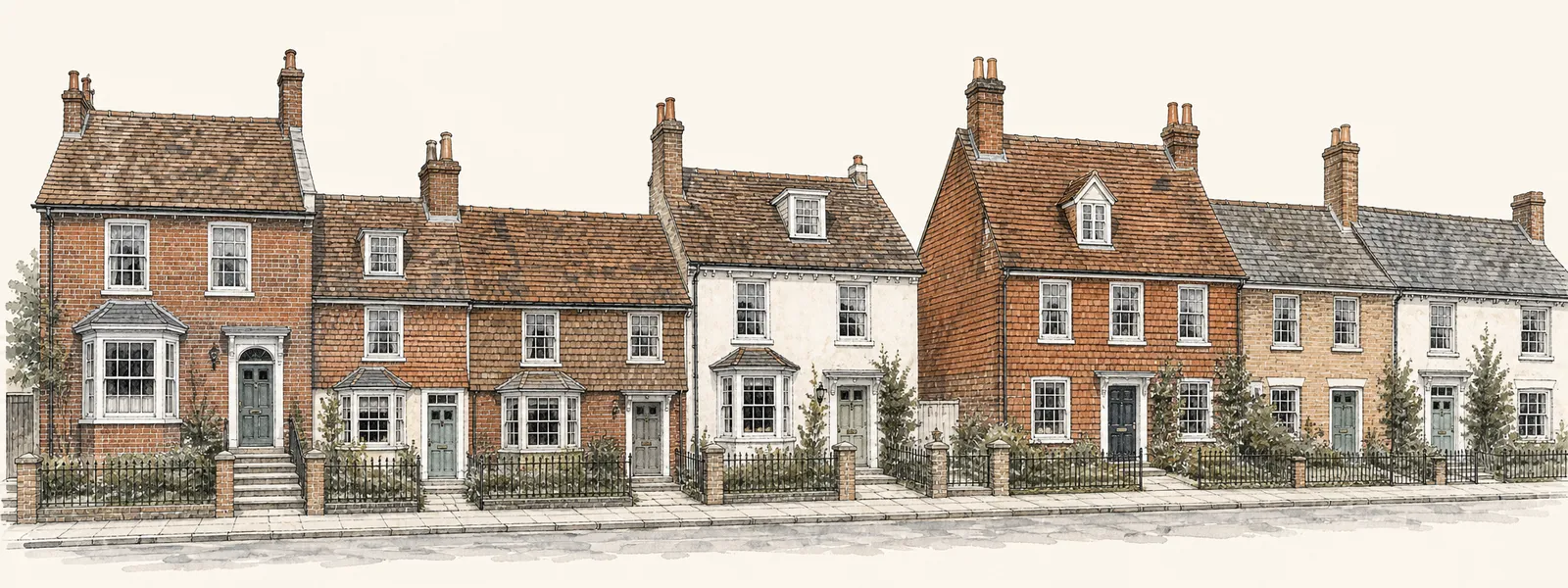
Cuckfield was a market and coaching town on the London to Brighton turnpike, and the record has about 50 coaches a day passing through in 1820. It also has a hall built in 1897 for Victoria's Diamond Jubilee. Those are the facts we hold, and they say one clear thing: this is an old settlement, with buildings from several eras sitting next to each other.
The town also missed out on the railway. Local landowners objected, and the line went through neighbouring Haywards Heath instead, so Cuckfield grew without a station of its own. The old buildings were left to stand among later infill, and a single street can hold roofs of quite different ages and builds, which is why we survey each house on its own merits.
The Queen's Hall of 1897 is a building with a known date. A house roof rarely comes with one, so we read its age in the loft instead, from the sawn timbers, the nails, the battens and the back of the covering, and the quote is written from what we find there.
What we can say is that older houses bring a familiar set of conditions to a rooflight job, and the survey is built to find them.
Old timbers, modern units
Older roofs often have rafters that are not at modern spacing. A standard roof window is made to fit between rafters at a regular gap, so on an older roof the opening may need an extra trimmer or a bespoke width. This is routine work, but it has to be allowed for in the structure, and it affects the price.
Floors matter as well. A loft that has been used as a store for decades may have joists that carry boxes, not people. If you plan to turn it into a room, a structural check comes before any talk of glass. Cutting a fresh opening also brings in an inspector, who looks at what holds the roof up, how it keeps the weather out and how it behaves in a fire.
Extensions and add-ons
Later extensions to an old house usually have flat or low-pitch roofs. A flat roof rooflight and sometimes a roof lantern on a raised kerb suits them. Where the extension joins the old house, we look carefully at the junction, because that is where water most often finds its way in.
| Part of the house | What it needs | Unit to look at |
|---|---|---|
| Old tiled pitch | A trimmed opening and flashing to match the tiles | Roof window |
| Flat rear extension | Light spread across a deep room | Lantern or flat rooflight |
| Dark hall or landing | Daylight where no window can go | Sun tunnel |
| Street frontage | A slim frame that sits low | Conservation rooflight |
Sheet 03
What the planning position is
Scale: the village
Planning applications in the town go to Mid Sussex District Council. The national planning dataset records a conservation area for the village, designated in 1989, and it covers the centre. Mid Sussex has no published register of its Article 4 directions that we could find, so the position at your address stays unknown until you ask the council.
Our planning guide explains what the permitted development rights cover, and where flats and listed buildings differ. A flat has no such rights and needs planning permission. Listed houses in the village need listed building consent too, applied for alongside any planning.
Because the position cannot be confirmed from the published sources, we do not guess. The easiest route is a short email or call to the planning team with your address and a description of the rooflight, and a written reply that you keep. If the council says permission is needed, we can give you the unit details an application asks for.
Who inspects the work
Mid Sussex District Council runs its own Building Control service, and a registered building control approver is the private route. Either one will look at structure, weathering and the energy performance of the new unit. The details are in our Building Regulations guide.
If the building is a conversion, the freeholder normally owns the roof. Under a typical lease, the freeholder has to agree in writing before a leaseholder has any rooflight fitted. Theleasehold buildings page walks through the order of events. Check your own lease, because we do not give legal advice.
Sheet 04
Getting to an old town roof
Scale: the scaffold
A town that grew around a turnpike has a mixture of plots. Some houses stand on the street with a pavement in front. Others sit back with a front garden or a forecourt. That decides where a scaffold or tower can stand, and whether a licence is needed.
The route to the roof, the notice to neighbours, the licence for any scaffold on the pavement or road, and the Building Control route all go into a single written page in your quote, the access plan. Any pavement or road licence here comes from West Sussex County Council in its role as the highway authority, and we put in those applications, bay suspensions included. The licensing guide for scaffold and bays has the detail.
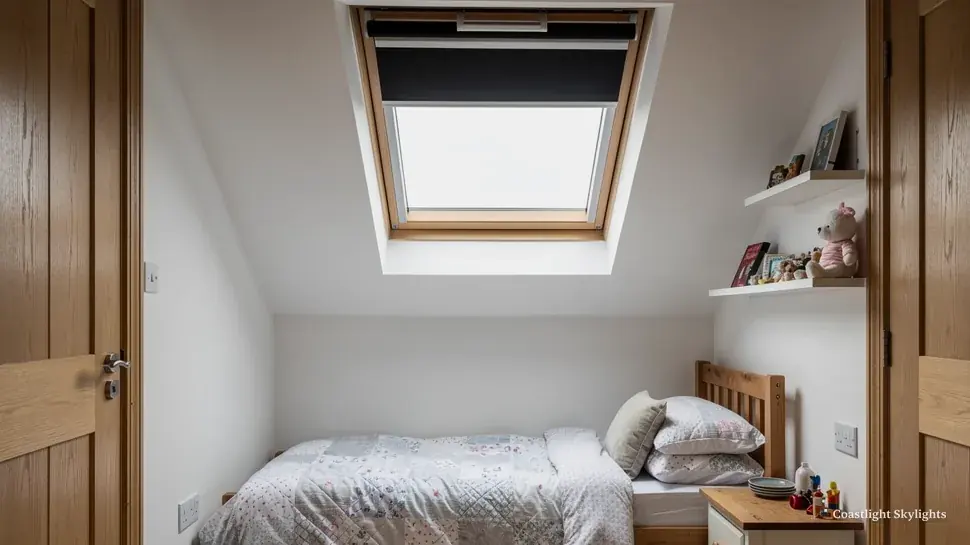
Weight is the other thing that shapes access. A large roof window or lantern is heavier than it looks, and the glass has to be lifted up the scaffold by hand or by a small hoist. We choose the route so that nothing is swung over a conservatory or a parked car, and we plan the removal of the old unit as carefully as the arrival of the new one. If the roof is steep, working platforms and edge protection go in before anyone steps onto the slope.
Neighbours close by
Where houses sit tight against each other, a scaffold can end up over a boundary, and a dropped tile or a swinging pole needs care. We tell neighbours before the work begins, set the scaffold within a safe working distance, and plan the lift so that glass is never carried over someone else's garden.
The village stands on the southern slopes of the Weald. Wherever a garden sits lower than the street, the rear roof is a longer way up from the ground than it looks from the front, and the scaffold is sized to match. The Party Wall etc. Act 1996 applies only if the work touches a shared party wall. Most rooflights do not, so it rarely arises, but we check at survey.
Sheet 05
Choosing a unit for a Cuckfield roof
Scale: the house
With the failures understood, the houses sorted and the planning position known, the choice becomes simple. Match the product to the roof, not to a catalogue photograph.

An old house with a pitched roof
A roof window sized to the rafter spacing, with a flashing kit that matches the covering. If the house has character you want to protect, our conservation rooflights have a slim frame that sits low in the roof plane. For a loft you plan to use, the roof windows page sets out the opening and fixed options, and the VELUX windows page covers that range.
Orientation is worth a thought at this stage. A roof window facing the sun lets a lot of light in, and in summer a lot of heat, so a blind or a different glazing specification may suit the room better than the default. A window facing north gives soft, even light all day and is often the better choice for a study or a studio. Tell us how you use the room, and we will suggest where the opening should go.
A flat-roof extension
A lantern gives height and a lot of light. A flat rooflight is slimmer and sits lower. Either lights a kitchen or sitting room from above. For energy performance, look at our energy efficient rooflights.
Windowless rooms
A sun tunnel brings daylight to a hall or bathroom, and an electric opening rooflight adds ventilation to a space that is hard to reach.
Read the costs page to see what shapes the price, and our guarantee for the workmanship cover.
Before the survey in Cuckfield
Do I need planning permission to replace a rooflight in Cuckfield?
Replacing like for like in an existing opening is usually different from adding a new one, but it depends on the house and on any direction or condition on it. Ask Mid Sussex District Council about your address and read the planning guide.
Is my house in the conservation area?
The national dataset records a Cuckfield conservation area centred on the village. Whether your address falls inside it is something Mid Sussex District Council can confirm.
Can a misted unit be repaired?
No. A failed sealed unit is assessed and replaced. We check the frame and the structure round it at the same visit.
How far is Cuckfield from you?
The town is a 17 mile drive north of central Brighton & Hove, comfortably inside our area. Book a free survey and we will confirm a date.
For the full range of work, return to our main page on skylights and rooflights in Brighton & Hove, or use the contact page.